Taking over rather than starting from scratch: a defensible choice
You dream of opening your own restaurant in Switzerland. Before building from zero, ask yourself a simple question: why build when you can inherit a base that is already solid? Taking over an existing restaurant offers a starting point that a new venture cannot give you.
A loyal customer base, a fully equipped kitchen, referenced suppliers, trained staff. On day one, you are not facing a void. You are taking the wheel of a vehicle that is already running.
But it is not a smooth ride. Taking over also means inheriting the previous owner's problems if you do not do your homework properly. This guide gives you the tools to leave nothing to chance.

Pros and cons: the honest assessment
Taking over a restaurant has real strengths. It also has real pitfalls. Here are both sides of the file, with no sugarcoating.
What you gain by taking over
The first advantage is the existing customer base. A restaurant that has been open for five years has built habits: the lunch regulars, the Sunday families, the neighborhood professionals. You do not have to win them over, you just have to avoid losing them.
Next come the equipment assets. Hoods, ovens, cold rooms, POS system: everything is in place. Equipping a professional kitchen from scratch represents an investment that varies widely depending on floor area, installed power, and target service level (bistro, fine dining, fast service). By taking over, you absorb that investment into the price of the business.
The supplier contracts are also already negotiated. Brewery, food wholesaler, laundry: the agreements exist. You inherit terms that are often more favorable than what a first-time operator can secure alone.
What can go wrong
Reputation is a double-edged sword. If the establishment has a tarnished image, you carry that baggage even if you are not responsible for it. Google reviews do not disappear when ownership changes.
The upfront investment costs can be surprising. A well-valued business sells at a price, and a partial renovation is often required to mark the transition. Budgeting for works is not optional, it is a necessity.
Finally, resistance to change sometimes comes from unexpected places: employees, long-standing suppliers, and even loyal customers who do not understand why you are changing the recipe of the soup of the day.
Takeaway: Taking over is faster than starting a new business, but not necessarily less risky. The difference is that the risks can be identified in advance, if you do the proper analytical work.
How to analyze a restaurant before acquiring it
Before talking about price, you need to understand what you are buying. Five analytical dimensions structure this step.
Location and local market
Spend time on site at different hours. Is the neighborhood busy at lunch? In the evening? On weekends? Who are your direct competitors within 200 meters? Also assess accessibility: public transit, parking, visibility from the street. A restaurant hidden in a dead-end alley can work with a rock-solid reputation, but that is an additional challenge for an incoming operator.
Observe pedestrian flows during service hours: the gap between a lunch service of 60 covers and one of 30 covers often comes down to 50 meters of visibility and a direct public transit connection.
Reputation: what the customers are saying
Systematically review Google, TripAdvisor, and social media. Do not just read the overall rating: dive into the comments from the past 12 months. Look for recurring trends, both positive and negative.
A restaurant with 4.2 stars on 300 reviews is more reassuring than one with 4.8 stars on 12. The volume of reviews indicates a real flow of customers. A drop in the average rating over the past 6 months is a strong signal that something has deteriorated (staff, kitchen, management).
Equipment condition
Ask for a detailed inventory and, if possible, have it verified by a professional. Check the age of the equipment, the latest service records, the condition of the hoods, ventilation, and cold rooms. A gas oven that fails two months after handover can cost tens of thousands of francs, and non-compliant ventilation can halt your operations until brought up to code.
Financial analysis: the heart of the file
Ask for the last three annual balance sheets and income statements. Analyze annual revenue, gross margin, payroll, rent, and net profit. This review of the financial history is essential for building your own profitability projections.
In Swiss foodservice, two line items dominate the P&L: payroll (including CCNT social charges, see below) and cost of goods. If the restaurant you are looking at shows ratios atypical for its category, request detailed explanations before going further.
Also look at the trend: a restaurant whose revenue has been declining for two years gives you a clear signal. Either the seller is selling because things are tough, or the local market is suffering. In either case, you need to know why.
For a deeper dive into methods for valuing a going concern, see our guide on valuing a going concern in Switzerland.
Daily cash reports: the moment of truth
The balance sheet tells you what the accountant reported. The daily cash reports for the last 12 months tell you what is actually happening. Ask for them systematically. Look at the monthly breakdown: an annual revenue of CHF 650'000 spread evenly does not tell the same story as the same revenue concentrated in July, August, and December. Seasonality determines your off-season cash needs.

Financial valuation and price negotiation
What is the restaurant you want really worth? The answer is not in the asking price set by the seller.
Applicable valuation methods
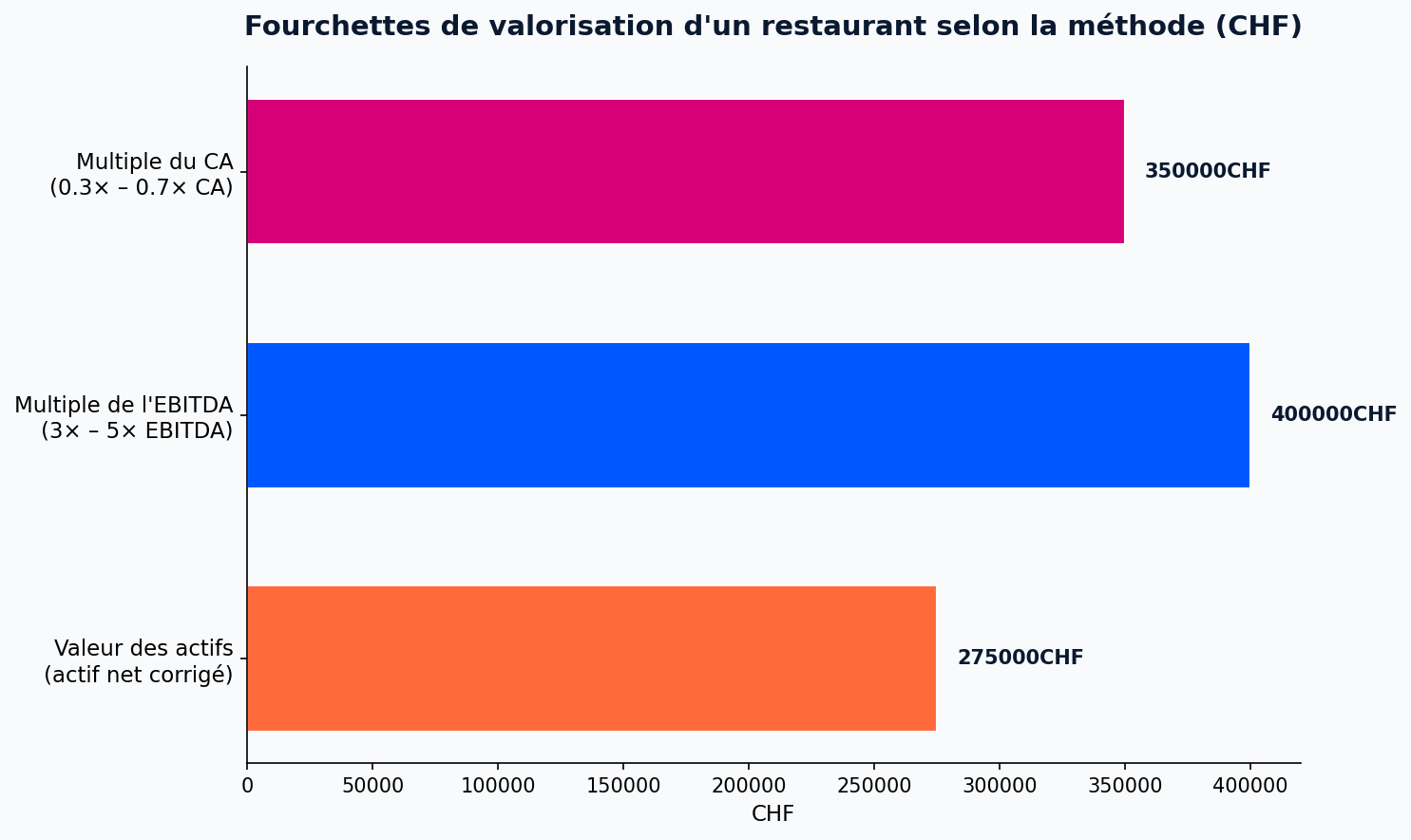
Three approaches coexist in Swiss practice:
| Method | Principle | Typical use |
|---|---|---|
| Revenue multiple | Percentage of annual revenue adjusted for location, lease, and margin | Brasserie, neighborhood business |
| EBITDA multiple | Several times earnings before interest and amortization | Restaurant with an established profitability track record |
| Asset value | Book value of equipment and going concern | Fast food, low-valuation business |
In practice, negotiation revolves around a combination of these methods. Physical assets (equipment, fit-out) and intangible assets (customer base, name, location) all enter the equation. The ranges applicable to each approach depend heavily on location, remaining lease term, and historical profitability. Gastroconsult, the sector's reference accounting firm backed by GastroSuisse, publishes useful sector benchmarks and advises on these valuations on a case-by-case basis.
Planning a works budget
Even a restaurant in good condition often needs an update. Factor this investment in from the negotiation stage: if you know the dining room needs CHF 40'000 of renovation, integrate it into your purchase offer. Bring in an independent expert for the assessment. A broker specialized in business transfers or a chartered accountant with foodservice experience will save you from nasty surprises.
Legal and administrative checks: leave nothing unexamined
This is the step that rushed buyers skip. It is also the one that produces the most post-closing disputes.
Contracts and the commercial lease
The commercial lease is the most strategic element. Check its remaining term, the renewal conditions, and above all: does the landlord agree to transfer the lease to the buyer? A non-transferable lease can bring the entire deal down. In some cantons, termination for the landlord's own use remains possible at term: ask the landlord about their intentions over a 5-year horizon.
Also review supplier contracts. Some include termination clauses in case of change of ownership, particularly brewery contracts with exclusivity provisions. Identify which ones before signing anything.
Liabilities: the exact rule under Art. 181 CO
The rule is more nuanced than what circulates in discussions among buyers. Two scenarios must be distinguished, with radically different consequences.
Case 1: share deal (buying shares of an SA or quotas of a Sàrl). You acquire the legal entity with all of its liabilities, visible or not. Legal due diligence is therefore critical.
Case 2: asset deal with transfer of assets and liabilities. Art. 181 CO provides that seller and buyer are jointly and severally liable for three years for the transferred debts, from the date of notice to creditors or publication in the press. Known debts pass to the buyer. Unknown or hidden debts do not automatically bind the buyer, but official notice to creditors is mandatory to make the transfer enforceable.
Practical consequence: an asset deal without an exhaustive creditor list and without proper notification exposes you to unexpected claims. You must have this step handled by a lawyer or a notary.
Personnel and Art. 333 CO
In case of a business transfer, the employment contracts of employees pass automatically to the buyer with all their rights and obligations, unless the worker individually objects. This is Art. 333 CO. You do not pick the team: you inherit it, along with the accrued seniority.
Two consequences that many buyers discover too late:
- The collective bargaining agreement (CBA) in force is maintained for at least one year after the transfer.
- The former and the new employer are jointly and severally liable for wage claims due before the transfer and until their normal term.
Meet the key employees before signing. Their departure after the takeover can destabilize operations far faster than one might think.
CCNT and 2026 minimum wages
Foodservice in Switzerland is covered by the National Collective Labor Agreement (CCNT) for the hospitality industry, declared generally binding since 2017. It applies to all establishments, whether or not they are members of GastroSuisse. You do not choose it, you are subject to it.
The 2026 minimum wages (published by the social partners at l-gav.ch) for a full-time employee aged 18 or over:
- Category I (no formal training): CHF 3'713 per month
- Category II (AFP, 2 years of training): CHF 4'070
- Category III a (CFC): CHF 4'528
- Category IV (federal professional certificate): CHF 5'293
Added to these: a weekly working time of 42 hours (43.5 h for seasonal workers, 45 h for very small establishments), a mandatory 13th-month salary (100% of a monthly wage), and GastroSocial contributions (sector pension fund).
Apply these minimums to the actual payroll you are taking over: if the seller pays below the CCNT minimum, you will need to correct this immediately, and your pro forma P&L must reflect it before signing. This is one of the most common adjustments in post due diligence.
VAT: the eat-in versus take-out equation
Foodservice is the only sector that simultaneously applies two VAT rates depending on the sales channel. ESTV rule in force since 01.01.2024:
- 8.1% (standard rate) for on-premises consumption
- 2.6% (reduced food rate) for take-out sales and deliveries
To benefit from the reduced rate, the ticket or invoice must explicitly state "take-out", and the ESTV requires organizational measures (signage, separate flow) as soon as the establishment has more than 20 seats. The impact on margin can be significant for a restaurant with a large take-out share (snacking, pizzeria, tea room): anticipate this in your projections.
Cantonal license and authorizations
Foodservice is subject to cantonal, not federal, regulation. The operator must hold a recognized qualification before opening. Three examples from French-speaking Switzerland:
- Geneva (LRDBHD): mandatory cantonal café operator diploma, issued after approximately 100 hours of training on 5 modules (Geneva legal framework, labor law, food safety, accounting, related laws). Authority: Police du commerce et de lutte contre le travail au noir (PCTN). Details at ge.ch.
- Vaud (LADB): Certificat cantonal d'aptitudes (CCA), earned through 8 GastroVaud modules and an exam. Equivalences are possible with a recognized Swiss hotel school diploma.
- Valais (LHR): exam in 3 modules (laws, accounting, labor law), operating authorization granted by the municipal council, equivalences assessed by the cantonal Office for Industry, Commerce and Labor.
Verify before signing that the current operator's qualification is transferable or that you can obtain yours within the required timeframe. A denied or delayed permit blocks the opening and blows up the cash plan.
Recommended tool: GastroSuisse, the umbrella association for Swiss foodservice, publishes a detailed checklist for taking over an establishment. A reference document to work through point by point in your due diligence.
Financing and business plan: building a solid file
You have found the right restaurant and the price has been negotiated. Now, how do you finance the operation?
Available sources of financing
Most takeovers combine several sources:
- Equity: in Swiss French-speaking market practice, banks typically require a personal contribution representing 20% to 30% of the total amount.
- Bank loan: Swiss banks finance business takeovers (UBS, Raiffeisen, BCV, cantonal banks), but require a solid business plan and tangible collateral.
- Seller financing: the seller agrees to defer part of the price, usually subordinated to the bank loan. This is a positive signal to the bank about the seller's confidence in the viability of the project.
- CRC-PME guarantee: the Coopérative romande de cautionnement PME can guarantee a bank loan up to CHF 1 million, with the Confederation covering 65% of the loss risk. A particularly relevant instrument when equity is tight.
- Cantonal support: some cantons have their own complementary schemes through their economic development offices.
The SECO KMU portal centralizes information on federal and cantonal support available to SME buyers, including in foodservice.
RHT: a cash cushion worth knowing about
The Réduction horaire de travail (RHT), also known as short-time work, allows an employer to have unemployment insurance cover 80% of the loss of earnings for unworked hours in case of a temporary and unavoidable drop in activity. It is relevant in several takeover scenarios: strong seasonality, renovation work, a temporary decline in traffic after the handover.
Minimum notice of 10 days to the cantonal authority (ACt), processing via the unemployment fund chosen by the employer. Details at arbeit.swiss. RHT does not replace healthy cash management, but it can save a season.
Building a convincing business plan
Your business plan is not an academic exercise. It is the document that will convince your banker and structure your early decisions. It should cover:
- Analysis of the local market and of the competition
- Revenue projections over 3 years, based on actual historical data
- Pro forma P&L with payroll (at CCNT minimums), rent, and cost of goods
- Month-by-month cash plan over 12 months
- Transition budget and planned initial investments
Build a ramp-up period of 6 to 12 months into your projections, during which revenue may dip before stabilizing. Swiss banks value quantified realism more than optimism.
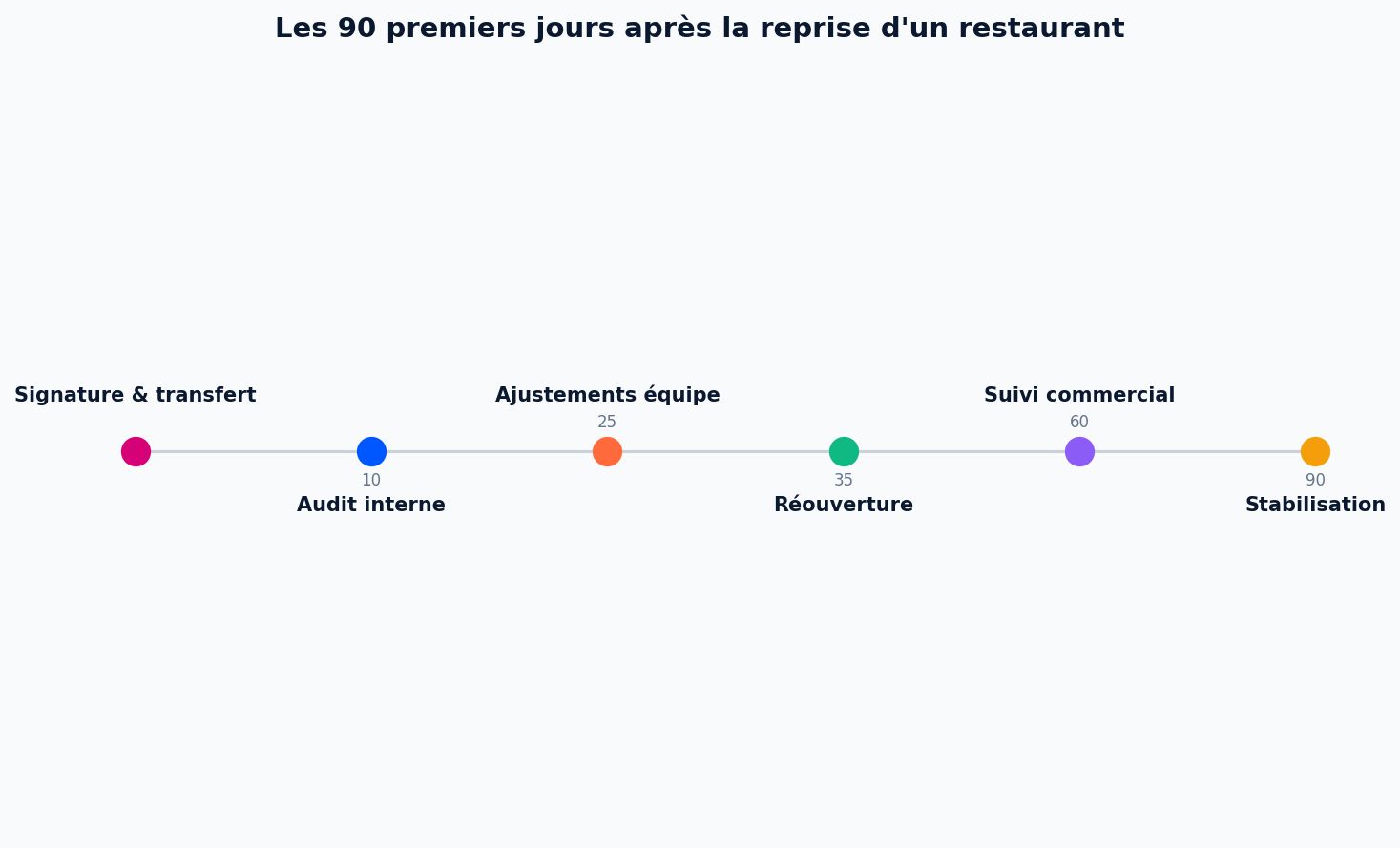
Transition and post-takeover management: the first 90 days
Signing is not the end of the work. It is the beginning. The first 90 days of a takeover often define the trajectory of the next 3 years.
Communication with the team
Hold a meeting with the full staff within the first 48 hours. Introduce yourself, explain your vision, listen to their concerns. Uncertainty is the main enemy of performance during a transition.
Identify the operational pillars: the head chef who has been in place for five years, the server whom every regular recognizes. Retaining them is your top priority. A chef's departure in the first three months can sink your Google reviews and send regulars to the competitor next door.
Building your turnaround plan
Do not change everything at once. Introduce your changes gradually and legibly. If you modify the menu, explain why to your regulars. If you change opening hours, communicate in advance.
Your turnaround plan can include:
- A menu update (keeping a few signature dishes)
- A social media presence if it was missing
- A partial visual refresh (paintwork, signage, terrace)
- An online reservation system if the restaurant had none
Managing suppliers
Meet your key suppliers in the first two weeks. Confirm continuity of contracts, negotiate if you see room for improvement, but do not cut established relationships without good reason. Supplier reliability is often worth more than a few cents saved by switching partners.
The Swiss foodservice market: what the numbers say
A few benchmarks to place your project in the reality of the sector.
The weight of the sector
According to GastroSuisse, its member establishments employ roughly 250'000 people and welcome close to 2.5 million customers per day. Foodservice remains one of the major employing sectors of the Swiss economy, with a high turnover of operators: the takeover market is permanently active.
Locations and price levels
Prices for restaurant businesses in French-speaking Switzerland vary widely depending on several factors:
- Location (city center, tourist area, outskirts, rural)
- Size of the dining room and condition of the equipment
- Historical profitability demonstrated by the accounts
- Remaining lease term and its conditions
- Presence of a terrace or not (a major differentiator in Geneva or Lausanne)
Offers start at a few tens of thousands of francs for very small establishments in less central areas, and can exceed several hundreds of thousands of francs for well-placed addresses with an established customer base. The asking price is a starting point for negotiation, not a verdict.
Cantonal regulations: no uniformity
Switzerland does not have a single body of law for foodservice. Each canton defines its own requirements regarding operating permits, alcohol licensing, and mandatory training. Geneva applies the LRDBHD with its cantonal café operator diploma. Vaud applies the LADB and the Certificat cantonal d'aptitudes. Valais applies the LHR. Always check with the municipality and the relevant cantonal office before any acquisition: the same file can be accepted in one canton and rejected in another.
Particularly dynamic zones
Geneva, Lausanne, Zurich, Basel, and tourist resorts (Zermatt, Verbier, Lugano) concentrate the most visible opportunities. But mid-sized cities such as Fribourg, Sion, or La Chaux-de-Fonds offer more accessible entry prices and less intense competition.
If you are looking for restaurants to take over, PME-Market lists ads across all 26 Swiss cantons, with the key financial information (revenue, rent, asking price) to compare opportunities before contacting a seller. You can also consult our guide to buying a business in Switzerland to structure your approach.
Point of attention: Tourist areas deliver high revenue during the season, but seasonality can put off-season cash flow under severe strain. Analyze monthly revenue, not just annual revenue.
Checklist before signing
Before putting your signature on the transfer deed, here are the non-negotiable points that must be validated.
| Area | Item to check | Status |
|---|---|---|
| Financial | Last 3 balance sheets and income statements | To obtain |
| Financial | Daily cash reports for the last 12 months | To obtain |
| Legal | Commercial lease: term, transfer conditions | To verify |
| Legal | Art. 181 CO: creditor notice and list of known debts | To confirm |
| Legal | No tax or social security debts on the seller's side (certificates) | To confirm |
| Operational | Detailed inventory of equipment and its condition | To produce |
| HR | Staff list, contracts, seniority, CCNT compliance | To obtain |
| Tax | VAT split 8.1% / 2.6% by sales channel | To analyze |
| Administrative | Cantonal license: transferable qualification or obtained in time | To confirm |
| Reputation | Review of online ratings over the last 12 months | To perform |
For exhaustive due diligence, the official GastroSuisse checklist remains the sector reference in Switzerland. It covers aspects that even professionals sometimes forget.
Frequently asked questions
How much does it cost to buy a restaurant in Switzerland?
Restaurant goodwill prices in French-speaking Switzerland vary widely depending on location, dining-room size, equipment condition, historical profitability and remaining lease term. Listings start at a few tens of thousands of francs for very small venues in less central areas and can exceed several hundred thousand for well-placed addresses. The asking price is a starting point for negotiation, not a final verdict. Always ask for the last three balance sheets before making any offer.
Are the seller's debts transferred when taking over a restaurant?
The answer depends on the structure of the transaction. When you buy the company itself (SA or Sàrl), you inherit the entire liability side of the balance sheet. When you take over the business with assets and liabilities, Art. 181 CO provides for joint liability of seller and buyer for three years on known debts, from the moment creditors are notified or the transfer is published. Notifying creditors is mandatory to make the transfer enforceable. Always have this step supervised by a lawyer or notary.
What authorisations are required to take over a restaurant in Switzerland?
The restaurant industry is governed by cantonal law, not federal law. Geneva applies the LRDBHD and requires a cantonal caterer diploma (training of about 100 hours, PCTN authority). Vaud applies the LADB and requires a Cantonal Certificate of Aptitude, obtained after 8 GastroVaud modules. Valais applies the LHR with a 3-module exam and a municipal authorisation. Before signing, verify that the current operator's licence is transferable, or that you can obtain yours in time. A non-transferable permit can block the entire transaction.
What happens to restaurant employees during a takeover?
Art. 333 CO imposes the automatic transfer of employment contracts to the buyer, with all acquired rights (seniority, salary, holidays), unless the employee objects individually. The applicable collective bargaining agreement is maintained for at least one year after the transfer. The former and the new employer are jointly liable for wage claims that became due before the transfer. You cannot therefore choose to keep only some employees. Meeting key staff before signing is essential.
Does the CCNT apply to my restaurant after the takeover?
Yes. The National Collective Labour Agreement for the hospitality industry (CCNT) has been mandatory since 2017 and applies to all establishments, regardless of membership in GastroSuisse. For 2026, minimum salaries for a full-time employee aged 18 or over are set at CHF 3,713 in category I, CHF 4,528 in category III (federal certificate), CHF 5,293 in category IV (federal diploma). A weekly working time of 42 hours and a mandatory 13th salary apply. If the seller pays below the CCNT minimum, you will need to correct this from day one: factor it into your operating budget.
How does VAT work in the Swiss restaurant industry?
The industry applies two rates depending on the sales channel. Since 01.01.2024: 8.1% (standard rate) for on-site consumption and 2.6% (reduced food rate) for take-away sales and deliveries. To qualify for the reduced rate, the receipt or invoice must explicitly mention "take-away", and the ESTV requires distinct organisational measures as soon as the establishment offers more than 20 seats. This rule has a significant impact on the margins of any restaurant with a take-away share.
How do you finance the takeover of a restaurant in Switzerland?
Most takeovers combine several sources: equity (20 to 30% in standard banking practice), a conventional bank loan (UBS, Raiffeisen, BCV, cantonal banks), a subordinated seller loan, and a CRC-PME guarantee (Coopérative romande de cautionnement PME), which can guarantee up to CHF 1 million, with the Confederation covering 65% of the loss risk. Short-time work compensation (RHT) can also serve as a cash flow cushion during a temporary drop in activity. A solid business plan with 3-year projections remains essential.
Is it better to buy the goodwill or acquire the company?
The two approaches have very different implications. A share deal (SA or Sàrl) gives you access to all the assets, but also to all the liabilities, including hidden tax or social security debts. Buying the goodwill with assets and liabilities triggers Art. 181 CO (three-year joint liability for known debts after creditor notification), but better limits the risk of the asset deal being captured by an unknown liability. For buyers without legal experience, an asset deal with rigorous due diligence is generally safer. Consult a lawyer or fiduciary before making the choice.
How long does a restaurant takeover take in Switzerland?
The full process, from first visit to signature of the transfer agreement, takes an average of 3 to 6 months for a well-prepared transaction. This timeline includes the analysis and due diligence phase (4 to 8 weeks), price negotiation, the financing file, the steps for the cantonal licence, the creditor notification under Art. 181 CO, and the drafting of the agreement. A rushed takeover in less than 2 months is a red flag.
What are the most common mistakes when taking over a restaurant?
Frequent mistakes: failing to request monthly cash register statements (annual turnover hides seasonality), neglecting the transferability of the commercial lease, ignoring the VAT gap between on-site and take-away, underestimating the impact of CCNT minimums on the wage bill, omitting the creditor notification required by Art. 181 CO, changing too many things at once after the takeover, and failing to verify the transferability of the cantonal licence before signing.
Related articles

Business Succession in Switzerland: Complete Guide to Selling or Acquiring an SME
Complete guide to business succession in Switzerland: valuation, taxation, legal aspects, and advice for selling or acquiring an SME.
Buying a Business in Switzerland: Complete Guide for Entrepreneurs
Step-by-step guide to acquiring a Swiss business: platforms, due diligence, financing, cantonal specifics. Everything you need to know to buy a business in Switzerland methodically.
Selling Your Business in Switzerland: Complete Guide 2026
Complete 2026 guide to selling your business in Switzerland: valuation methods, legal aspects, tax implications, finding buyers, and avoiding costly mistakes.