Why sell your business in Switzerland in 2026?
The Swiss business transfer market has entered its most active decade. According to Dun & Bradstreet (March 2024), 101,427 Swiss SMEs have an owner or shareholder aged 60 or over, with open succession to resolve over the coming years. In parallel, Berney Associés recorded 519 business transactions published in Switzerland in 2024, a slight increase over 2023 (509) but still below the post-Covid peak of 2022 (591).
These numbers tell a concrete story: the supply of businesses for sale is growing faster than the pool of buyers. The KMU Next foundation estimates that roughly one Swiss SME in three disappears for lack of a buyer. For a broader view on transfer, takeover and succession, see our complete guide to business succession in Switzerland. A well-prepared seller with a clean file and realistic valuation stands out immediately in this flow. A seller who improvises risks joining the 33% who close down without transmitting.
The three main motivations for sellers
Retirement remains the number one driver. You have run your grocery store in Fribourg for twenty years, your son works at Nestlé and has no interest in taking over, and you want to exit at 62 or 65 with fair compensation for your years of effort. According to data published by kmu.admin.ch, only 42% of transfers happen within the direct family line, and 11% to another family member. The majority of sellers must therefore look outside the family circle.
Wealth diversification is the second strong motivation, especially for medium-sized business owners. Your business often represents 70 to 90% of your net worth. Selling lets you convert this illiquid asset into cash invested in rental property, a 3rd pillar, or a securities portfolio. It is also the strategy that protects your spouse if you pass away first.
The third reason remains structural pressure: rising commercial rents in Geneva and Zurich, digital competition in retail, shifting post-pandemic habits in restaurants. Selling under pressure is not a failure; it is a defensive decision that deserves exactly the same preparation as a serene sale.
Preparing the sale: how long does it really take?
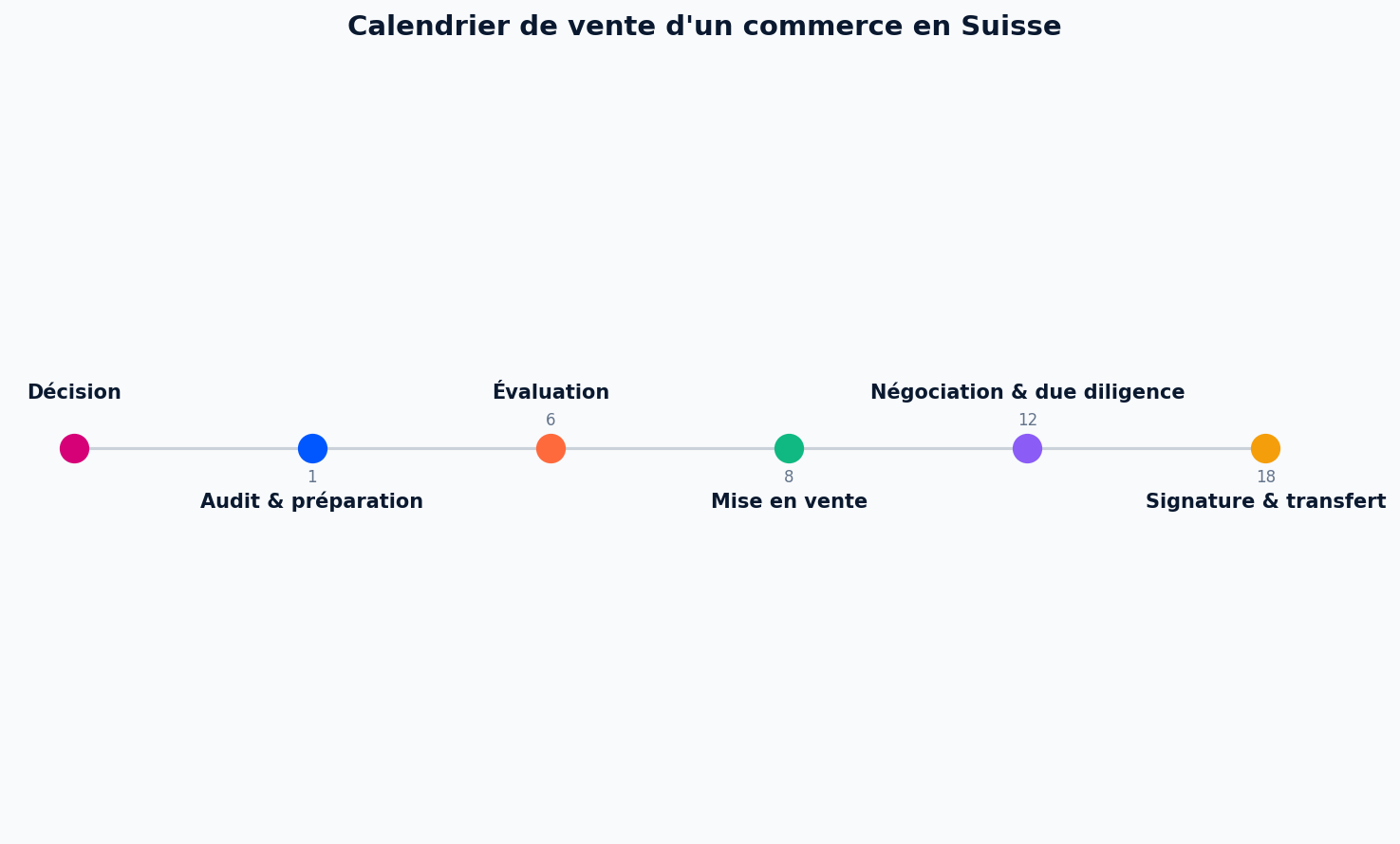
The short answer: 18 to 36 months from decision to signing, according to the official KMU.admin.ch guide and the practice of French-speaking Swiss trustees like Berney and BDO. This timeline always surprises people. It is not bureaucratic; it reflects three cycles that cannot be compressed: cleaning up accounts over 3 fiscal years, building a credible seller file, and finding a solvent and aligned buyer.
A seller who announces the sale in March and hopes to sign in September structurally leaves money on the table. They have not had time to renegotiate the lease, document customer loyalty, or remove personal expenses from the books. The buyer senses it and adjusts the offer downward.
The financial and operational audit
A serious preliminary audit covers four concrete dimensions:
- Restated accounts over 3 to 5 years: remove hidden personal charges (personal company car, phone, family meals), normalise director compensation to market rates (an owner paying themselves CHF 60,000 for 50 hours a week when the market pays CHF 120,000 artificially inflates EBITDA)
- Dependency on key people: if 40% of revenue comes from clients who come for you personally, the buyer will apply a 15 to 30% discount to the valuation
- Commercial lease: remaining duration, assignment clause, rent at or below market, termination conditions. A lease with 18 months remaining is structurally worth less than a 7-year lease transferable without restriction
- Supplier contracts and licences: exclusivities, change-of-control clauses, cantonal operating licences (restaurants, pharmacies, medical services) that do not transfer automatically
Documents to prepare before going to market
Gather these elements as soon as the decision to sell is made, not when a buyer asks for them:
- Balance sheets and profit and loss statements for the last 3 fiscal years, validated by your trustee
- Tax returns of the company and the director over the same period
- Commercial lease with the signed assignment addendum or the landlord's written consent in principle
- Current employment contracts and AVS/LPP plans, especially for employees with 2nd pillar benefits above the legal minimum
- Detailed list of equipment included in the sale with book value and replacement value
- Supplier contracts and operating licences, with identification of change-of-control clauses
- Anonymised customer register (top 10 by revenue, recurring vs one-off share)
Practical tip: Do not hide weaknesses. A buyer who discovers a tax dispute or lost client after signing will activate the liability warranty and claim tens of thousands of francs from you two years later. Upfront transparency, documented in a risk table annexed to the seller file, secures the final price.
Business valuation: which method to choose?
How much is your business worth? A burning question, answered by building a defensible range. In Switzerland, the following three methods coexist and complement each other: crossing them produces a credible bracket, not a single number.
| Method | Principle | Typical use | Limitation |
|---|---|---|---|
| EBITDA multiple | Value = normalised EBITDA × sector multiple | All SMEs with recurring profitability | EBITDA must be honestly restated |
| Revenue multiple | Value = revenue × coefficient (0.3 to 1.0 by sector) | Very small businesses, simple transactions | Ignores actual profitability |
| Revalued net assets | Value = real assets - liabilities | Asset-heavy activities, industry, commercial real estate | Understates goodwill for an established brand |
| DCF | Sum of discounted future cash flows | Growing SMEs, recurring models | Highly sensitive to assumptions |
The EBITDA multiple method dominates in practice for Swiss SMEs. According to the Argos Index reported by Berney Associés, the broader European market was at 9.5x EBITDA in Q3 2024. Swiss SMEs sit closer to 6.5x on average, and independent neighbourhood businesses meaningfully below.
Multiples observed by sector in Switzerland
The following ranges reflect the practice of trustees and business brokers active in the French-speaking and German-speaking Swiss markets in 2024-2025. They serve as an anchor point, not an absolute rule.
- Restaurants (restaurants, cafés, brasseries): 3x to 5x normalised EBITDA. Dependency on the owner and location = discount. Established brand with 10+ years of history = premium. Our guide on taking over a restaurant in Switzerland details sector-specific aspects from the buyer side
- Hotels: 4x to 6x EBITDA if the building is included, higher if the balance sheet carries undervalued real estate relative to market
- Neighbourhood retail (grocery, tobacco, kiosk): 2x to 4x EBITDA, sometimes valued as a multiple of gross margin when net margin is thin
- Business services (trustees, IT, consulting): 4x to 6x EBITDA if the client portfolio is recurring and transferable
- Wellness and beauty (salons, spas, studios): 2.5x to 4x EBITDA, marked discount if the clientele follows the practitioner
- Artisanal production (bakery, butcher, workshop): 3x to 5x EBITDA, premium if the brand is regionally recognised
What really moves the final price
Beyond the base multiple, five factors adjust the valuation by 15 to 40% up or down:
- Location: a restaurant at Lausanne Flon is structurally worth more than an identical one in Payerne, at comparable revenue
- Client transferability: clients loyal to the brand = transferable value, clients loyal to the owner = value that leaves with you
- Revenue diversification: depending on more than 30% from a single client or supplier translates into a mechanical discount
- Equipment condition and installations: a professional oven installed in 2023 is an asset, an oven from 2008 becomes a future charge for the buyer
- Lease quality: duration, assignment clause, rent at market or below (an undervalued lease is a hidden asset to value)
For a defensible valuation, engage an independent trustee or M&A expert. To go deeper on valuation mechanics, see our dedicated article on how to value a business in Switzerland. The official SECO/KMU guide on comparative value lists available governmental resources and confirms the multiples method as a recognised approach.
Legal aspects of the sale in Switzerland
Your structure's legal form drives the choice of transaction and the consequences that follow. This distinction is not administrative; it changes the net price you pocket after taxes, the residual liability you keep, and the exact perimeter of what you transmit.
Asset deal vs share deal
Asset deal transfers operational assets: clientele, brand, equipment, inventory, lease, and sometimes the retained employees. The buyer does not take on the selling company's liabilities: they start with a clean balance sheet. This is almost the exclusive form for sole proprietorships and general partnerships (individuals).
Share deal transfers the shares of the company (SA or Sàrl). The buyer becomes a shareholder and takes over the company with all its assets and liabilities, including unsettled tax obligations, ongoing litigation, and guarantees given to third parties. In return, this option opens a major tax lever for individual sellers (see Taxation section).
A practical rule: for an individual business selling for less than CHF 500,000, an asset deal simplifies the transaction. Above one million and in a corporate structure, a share deal is almost always studied first for the tax savings it enables.
Formalities and transfer of employment contracts
Transferring a business or shares involves several acts:
- Deed of sale drafted by a lawyer or notary depending on the canton. Geneva and Vaud typically use notarial deeds for share deals; Zurich and Basel accept private deeds with signature certification
- Entry in the cantonal commercial register for companies, via the Zefix portal or the cantonal counter
- Transfer of the commercial lease with written landlord consent (art. 263 CO). The landlord can only refuse for a legitimate reason but has a right to review the buyer's profile
- Notification to employees and consultation of staff representatives (art. 333a CO) before the transfer is concluded, not after
Two Code of Obligations articles must be known by heart. Art. 181 CO governs the transfer of assets and liabilities: the buyer becomes jointly liable for the debts assumed upon publication. Art. 333 CO makes the transfer of employment relationships automatic on the day of the sale. Contracts follow the business, unless the employee objects in writing. The former employer remains jointly liable for salary claims arising before the transfer for 2 years. If a collective bargaining agreement applies, it binds the buyer for at least 12 months.
Point to watch: Automatic contract transfer protects employees but may surprise a buyer hoping to reshape the team. Document clearly in the seller file the seniority, salaries, and specific clauses (company car, bonus, remote work). A well-informed buyer will not block the transaction on this ground.
Taxation of the sale: what you will actually pay
The taxation of a sale depends on two variables: your status (self-employed individual vs shareholder of an SA/Sàrl) and the type of deal (asset vs share). Between the most favourable and the most punitive scenario, the gap can reach 30 to 40% of the sale price. This difference is steered upstream, not at signing.
If you are self-employed (individual)
The sale generates a liquidation gain taxable as income, calculated as the difference between the sale price and the book value of the assets sold (release of hidden reserves + goodwill). By default this gain is added to your ordinary income and bears the full progressivity of the cantonal and federal scales. In Geneva or Vaud, a liquidation gain of CHF 400,000 can translate to 30 to 38% effective tax.
Art. 37b LIFD corrects this tax harshness for sellers who cease permanently. Three cumulative conditions:
- Age ≥ 55, or cessation due to disability
- Definitive cessation of all self-employed activity (no parallel restart)
- Separate taxation requested in the tax return of the cessation year
The liquidation gain of the last two fiscal years is then taxed separately from ordinary income, at 1/5 of the progressive scale (roughly 20% of the standard rate), per AFC circular no. 28. A notional pension buyback is allowed to absorb part of the gain. For a Vaud self-employed taxpayer aged 60 selling their workshop for CHF 800,000, the tax saving typically lands between CHF 80,000 and CHF 150,000 compared to ordinary taxation.
If your business is incorporated (SA, Sàrl)
In a share deal, the sale of shares held in your private wealth realises an exempt private capital gain under art. 16 para. 3 LIFD. This is the most powerful tax regime in the Swiss system for an entrepreneur, and one of the real reasons why moving to an SA/Sàrl before a sale can be worth several years of preparation.
Three traps to know:
- Indirect partial liquidation (art. 20a LIFD): if the buyer funds part of the price via distributions of non-operating substance within 5 years after the sale, and you sell at least 20% of the capital, part of the price is reclassified as taxable income. Addressed via an anti-IPL clause in the contract
- Transposition (art. 20a para. 1 let. b): if you sell to a company you control by 50% or more, the capital gain is reclassified as income
- Reclassification as professional securities trading: rare for a historical founder holding shares for years, but worth checking if you have multiplied sale-creation operations
In an asset deal sold by the company itself (not by you), the gain is first taxed at corporate level (≈ 11 to 21% depending on the canton in 2026), then a second time when the company distributes the proceeds to the shareholder. This double taxation explains why share deals remain the default option for sellers operating through a company.

Finding the right buyer: where and how
A good buyer is not the first one to wave a cheque. It is the one with solid financing, a project coherent with your activity, and the capacity to absorb the first 12 to 18 months without stalling. The Swiss market has three dominant profiles, worth knowing in order to target your distribution.
The three main buyer profiles
The individual buyer in career transition represents the majority of the market for businesses under CHF 1 to 2 million: a forty-something manager leaving a salaried position, a former manager of a large chain wanting to go independent, an expat returning to Switzerland. They combine personal equity of 20 to 30%, a bank loan, and often a partial withdrawal of their 2nd pillar (art. 5 LFLP). Long decision cycle (3 to 6 months), strong demand for transparency. To understand the logic of these profiles from the buyer side, our complete guide to buying a business in Switzerland details their decision-making path.
The industrial or consolidation buyer represents a narrower but faster-closing flow. This could be a regional competitor, a supplier looking to integrate vertically, or a sector group buying to consolidate. They often pay better (real operational synergies) but impose heavier due diligence and negotiate hard on warranties.
The management buy-in (MBI) and management buy-out (MBO) cover 23% of transfers according to kmu.admin.ch. The MBO happens with one or more company managers (fluid transition, financing typically via seller loan + bank credit + guarantee cooperative). The MBI brings in an external manager taking over leadership (riskier, tighter financing). Investment funds remain rare below CHF 3 million of EBITDA.
Confidentiality vs visibility: arbitrating smartly
The tension is real. Too much visibility and your employees learn about the sale from a client who saw the listing; too much confidentiality and you reach only three buyers via your trustee. Specialised platforms like PME-Market allow publication of a detailed listing (sector, canton, revenue range, price range) without revealing the business's identity until an NDA is signed.
Three channels to combine: the generalist PME-Market platform to reach individual buyers and MBIs; your trustee or a regional business broker for industrial buyers; and your own network via a targeted direct approach (3 to 5 pre-screened competitors or partners, never more). Due diligence only starts after an initial agreement in principle on the indicative price and perimeter, ideally formalised by a non-binding letter of intent (LOI).
Confidential listing: selling without alerting employees, clients, suppliers
Information leaks are the costliest accident in a business sale. An employee who learns of the sale through rumour starts planning their exit. A key client who learns from a competitor calls to renegotiate. A supplier who learns from a salesperson shortens payment terms. Each of these events drains 3 to 8% from the final value.
Swiss best practice rests on three principles:
- Anonymised listing: sector (gourmet restaurant, textile retail), canton or agglomeration (Lausanne region, Zurich north), revenue and EBITDA ranges, years of activity, price range. Never the brand, address, or storefront photo. A platform like PME-Market automatically produces this level of detail without revealing identity
- Buyer screening before disclosure: the buyer sends a first message with their profile and intent. You answer those who convince you and ignore the rest. A signed NDA always precedes the transmission of detailed accounts or a site visit outside business hours
- Internal communication timing: your employees and strategic clients must be informed after the signing of the sale contract, never before. Swiss law (art. 333a CO) requires consultation of staff representatives before the final transfer is concluded, but does not require publicly announcing the sale months earlier
In practice, a savvy seller builds a communication plan in three waves: trustee and lawyer at the very start; key employees (operations director, head chef) 2 to 4 weeks before signing under NDA; the rest of the team and clients within the 24 hours following signing, with the buyer present. This sequencing limits cascade departures and stabilises post-sale revenue, which protects the earn-out if part of the price is conditional.
Negotiation and closing: how to hold your price
You have a serious buyer with pre-qualified financing. The most delicate phase begins. Negotiation is not won by holding firm on everything, but by knowing exactly where to yield to obtain what matters. Three levers weigh more than the headline price: payment structure, warranties, transition period.
The contractual clauses that really matter
- Asset and liability warranty: you warrant the accuracy of the accounts and the absence of hidden liabilities. Swiss practice typically caps the warranty at 20-30% of the price, over 12 to 24 months for operational liabilities and 5 to 10 years for tax liabilities (matching AFC prescription deadlines)
- Earn-out: 10 to 25% of the price conditional on post-sale targets (revenue, EBITDA, client retention). A useful tool to bridge valuation gaps, a dangerous trap if the metrics are not auditable by a third party and you lose operational control during the period
- Non-compete clause (art. 340 to 340c CO): limited in place, time and type of activity. Maximum 3 years except in special circumstances, typically 2 years with a 20 to 50 km radius around the business sold. Swiss law does not require financial consideration (unlike French law), but the judge can reduce a clause deemed excessive (art. 340a para. 2 CO). The contractual penalty for violation cannot exceed one annual salary
- Conditions precedent: bank financing confirmed in writing, lease transfer approved by the landlord, required licences obtained (cantonal operating permit, health authorisation). Without these conditions, the sale closes without a safety net
- Transition period: 1 to 6 months depending on the complexity of the trade. Paid or unpaid, full-time or part-time, with or without signing authority. Needs to be framed precisely
Advisor fees: a budget to anticipate
A lawyer specialised in corporate law is essential above CHF 100,000 of transaction value. Fees observed in French-speaking Switzerland on a business sale between CHF 300,000 and CHF 1.5 M typically land between CHF 8,000 and CHF 25,000 for the lawyer (hourly rate CHF 350-500, including contract drafting, legal due diligence and negotiations). The trustee bills separately between CHF 5,000 and CHF 15,000 for tax structuring, restated accounts review, and liquidation gain calculation.
These fees weigh 2 to 4% of the sale price. Compare with the risk of a poorly drafted clause costing 10 to 20% of the price in post-sale litigation. The arbitrage is simple.
Buyer financing: what your buyer can actually mobilise
Your buyer almost never has the full sale price in cash. Understanding their financing stack lets you calibrate your price, accept or decline a seller loan, and estimate a realistic timeline between LOI and closing. The typical structure observed on the Swiss market for businesses between CHF 300,000 and CHF 2 M combines four building blocks.
| Source of financing | Typical share | Key conditions |
|---|---|---|
| Buyer equity | 20 to 30% | Minimum required by any Swiss bank; below that, almost automatic refusal |
| SME bank loan | 40 to 60% | Duration 5 to 10 years, indicative rate 2.0% to 4.5% in 2026 (SNB rate held at 0.0% in March 2026) |
| Seller loan (vendor note) | 10 to 25% | Duration 2 to 5 years, subordinated to bank credit, rate between 3 and 6% |
| 2nd pillar withdrawal (art. 5 LFLP) | 5 to 20% | Sole proprietorship or general partnership only, request within the first year of activity |
| Guarantee cooperative | Up to CHF 1 M | CRC (GE/VD/FR/NE/VS), BG Mitte, BG Ost-Süd, SAFFA. Confederation covers 65% of losses |
Two levers deserve your personal attention. The seller loan remains the most powerful tool to unlock a negotiation: by financing 10 to 25% of the price yourself over 2 to 5 years, you confirm your belief in the business's longevity, secure signing, and create a financial link that naturally disciplines the post-sale transition. The risk: the buyer defaults. Covered by a security interest on the business or a personal guarantee.
The Cautionnement Romand (CRC) and its German-speaking counterparts (cautionnementromand.ch, kmu-buergschaften.ch) enable a buyer without sufficient collateral to obtain bank credit up to CHF 1 M. The Confederation covers up to 65% of losses in case of default. This under-used mechanism unlocks many transfers that a bank would refuse on its own. Mention it to your buyer: you become more attractive to solid profiles with limited equity.
The costly mistakes: what sellers regret
Sales that end badly are almost never due to bad luck or unfavourable market. They follow repeated patterns, identified by trustees who have been handling these files for twenty years.
Underpricing or rushing the decision
Setting a price too low out of impatience to retire remains the most frequent mistake. Conversely, overpricing out of emotional attachment discourages serious buyers, extends the market listing by 12 to 24 months, and often ends in a steeper discount than the one refused at the start.
Rushing after the first offer is almost as costly. A seller who accepts the first proposal without putting their business into competition leaves on average 10 to 15% on the table. Collect at least three written expressions of interest before signing a LOI.
Family conflicts and misaligned expectations
In a family business, the sale resurfaces questions that day-to-day operations had buried: fairness among heirs who never worked in the business, the founder's legacy, identity attachment to the brand, allocation of the sale proceeds between spouses separated by matrimonial regime. These tensions, poorly handled, surface at the worst moment: two weeks before signing.
A frank conversation with all concerned members, six to twelve months before listing, ideally with a mediator or family notary, is worth more than improvised negotiation under calendar pressure.
Do not neglect post-sale obligations
Signing is not the end. Several obligations weigh on you for 2 to 10 years:
- Transition period supporting the buyer, often 1 to 6 months, contractualised with a precise scope
- Asset and liability warranties exercisable for 12 to 24 months for operational matters, up to 10 years for tax liabilities (AFC prescription)
- Art. 181 CO joint liability on assumed debts for 2 years
- Art. 333 CO joint liability on pre-existing salary claims for 2 years
- Tax returns for the sale year (art. 37b LIFD separate taxation must be formally requested, otherwise the full scale applies by default)
- Non-compete clause for 2 to 3 years depending on the contract
Plan these obligations into your personal calendar. Leaving your business does not mean closing the door on the day of signing.
Key takeaway: The sales that go best are those where the seller started preparing two years too early rather than one year too late. Preparation, not the market, makes the difference on the final price. A clean file, a mastered timeline, anticipated taxation, and the right buyer eventually shows up.
Frequently asked questions
How long does it take to sell a business in Switzerland?
Between 18 and 36 months from decision to signing, according to KMU.admin.ch and the practice of Swiss trustees. This timeline covers three cycles: restating accounts over 3 to 5 fiscal years, building a credible seller file, and finding a solvent buyer. A seller who compresses this calendar leaves on average 10 to 15% on the table, because they have not had time to renegotiate the lease, document customer loyalty, or remove personal charges from the books.
What valuation methods apply to a Swiss business?
Four methods coexist: the EBITDA multiple (dominant in Switzerland, around 6.5x on average SME per Argos Index Q3 2024, but 3x-5x for restaurants, 4x-6x for services), the revenue multiple (coefficient 0.3 to 1.0, for very small businesses), revalued net assets (asset-heavy activities), and DCF (growing SMEs). Trustees typically cross two methods to produce a defensible range, not a single figure.
What is the difference between asset deal and share deal in Switzerland?
An asset deal transfers operational assets (clientele, lease, equipment) without liabilities. It is the form used for sole proprietorships and general partnerships. A share deal transfers the company shares (SA, Sàrl) with all its assets and liabilities. Share deals open for individual sellers the private capital gain exemption (art. 16 para. 3 LIFD), while asset deals generate a liquidation gain taxable as income, with the favourable regime of art. 37b LIFD for sellers aged 55 and over.
How do I find a buyer without compromising confidentiality?
Three complementary channels: specialised platforms like PME-Market, which allow anonymised listings (sector, canton, financial ranges) before disclosure under NDA; your trustee or a regional business broker to reach industrial buyers; and a targeted direct approach on 3 to 5 pre-screened competitors or partners. Employees and clients are informed only after the signing of the sale contract, in line with art. 333a CO.
How is the sale of a Swiss business taxed?
For a self-employed seller, the liquidation gain is taxed as ordinary income, but art. 37b LIFD allows from age 55 a separate taxation at 1/5 of the progressive scale, plus a notional pension buyback. For a shareholder of an SA or Sàrl selling shares held in private wealth, art. 16 para. 3 LIFD exempts the capital gain. Three traps: indirect partial liquidation (art. 20a LIFD) in case of distributions within 5 years post-sale, transposition, and reclassification as professional securities trading.
What is a seller loan and how does it work?
A seller loan is a mechanism whereby the seller finances 10 to 25% of the price, repayable over 2 to 5 years at a rate between 3 and 6%. It unlocks transactions where the buyer has a solid business plan but limited equity. It also signals that the seller believes in the business's longevity, which reassures the main bank. The receivable is typically subordinated to bank credit and secured by a security interest on the business or a personal guarantee from the buyer.
How does the guarantee cooperative scheme work for financing a takeover?
Four guarantee cooperatives recognised by the Confederation operate: Cautionnement Romand (GE, VD, FR, NE, VS), BG Mitte (central cantons), BG Ost-Süd, and SAFFA (women entrepreneurs). They guarantee up to CHF 1 million per beneficiary with banks. The Confederation covers up to 65% of losses in case of default. The mechanism allows buyers without sufficient collateral to obtain a bank loan. Mention it in your listing: it broadens your pool of solvent buyers.
What are the costliest mistakes during a sale?
Three mistakes recur. Underpricing out of impatience to retire or overpricing out of emotional attachment. Accepting the first offer without creating competition (average cost: 10 to 15% of the price). Neglecting taxation by choosing an asset deal when a share deal would have activated art. 16 para. 3 LIFD. Add to these unresolved family conflicts and forgotten post-sale obligations (warranties activable up to 10 years on tax matters, art. 181 and 333 CO joint liability for 2 years).
What budget should I plan for lawyer and trustee fees?
For a sale between CHF 300,000 and CHF 1.5 million, plan CHF 8,000 to CHF 25,000 for a lawyer specialised in corporate law (hourly rate CHF 350-500, covering contract drafting, legal due diligence, negotiations) and CHF 5,000 to CHF 15,000 for the trustee (tax structuring, liquidation gain calculation, art. 37b LIFD separate taxation request). Total budget: 2 to 4% of the sale price. To be compared with the risk of a poorly drafted clause costing 10 to 20% in post-sale litigation.
Can I sell my business without employees and clients knowing?
Yes, the sale can remain confidential until the sale contract is signed. Swiss law (art. 333a CO) only requires consultation with staff representatives before the final transfer is concluded. A platform like PME-Market publishes your listing without revealing the brand or address. Buyers send a first filtered message, sign an NDA, and then access detailed accounts. Internal communication follows a three-wave sequence: trustee/lawyer, then key employees under NDA 2 to 4 weeks before signing, then the rest of the team and clients within the 24 hours following signing.
Related articles
Taking Over a Restaurant in Switzerland: The Complete Guide
Complete guide to taking over a restaurant in Switzerland: financial analysis, due diligence, financing, legal requirements and post-takeover management.
Business Succession in Switzerland: Complete Guide to Selling or Acquiring an SME
Complete guide to business succession in Switzerland: valuation, taxation, legal aspects, and advice for selling or acquiring an SME.
Buying a Business in Switzerland: Complete Guide for Entrepreneurs
Step-by-step guide to acquiring a Swiss business: platforms, due diligence, financing, cantonal specifics. Everything you need to know to buy a business in Switzerland methodically.