Business Succession in Switzerland: Complete Guide to Selling or Acquiring an SME

Nearly one Swiss SME in five will change hands by 2031. According to analyses by Credit Suisse and Bisnode D&B, more than 75,000 Helvetic companies face a transmission in the next five years, representing close to 500,000 jobs. Behind these figures lie as many human stories: founders retiring, partners splitting, heirs who do not want to take over. And for each case, a process that can take two to five years if it is not anticipated in time.
This guide covers the entire journey, from initial preparation to the post-signature transition, with the Swiss specifics on taxation (Art. 16, 18, 20a FITA), legal framework (Art. 181 and 333 CO, Merger Act) and practical execution. Whether you are seller or buyer, every step counts.

What is a business transmission?
Business transmission refers to the process by which an owner transfers their company to a successor. Simple in appearance, the process covers very different realities depending on the legal structure (sole proprietorship, LLC, stock company), the buyer profile (family, employee, external third party) and the seller's objectives (liquidity, continuity, cultural legacy).
The three main forms
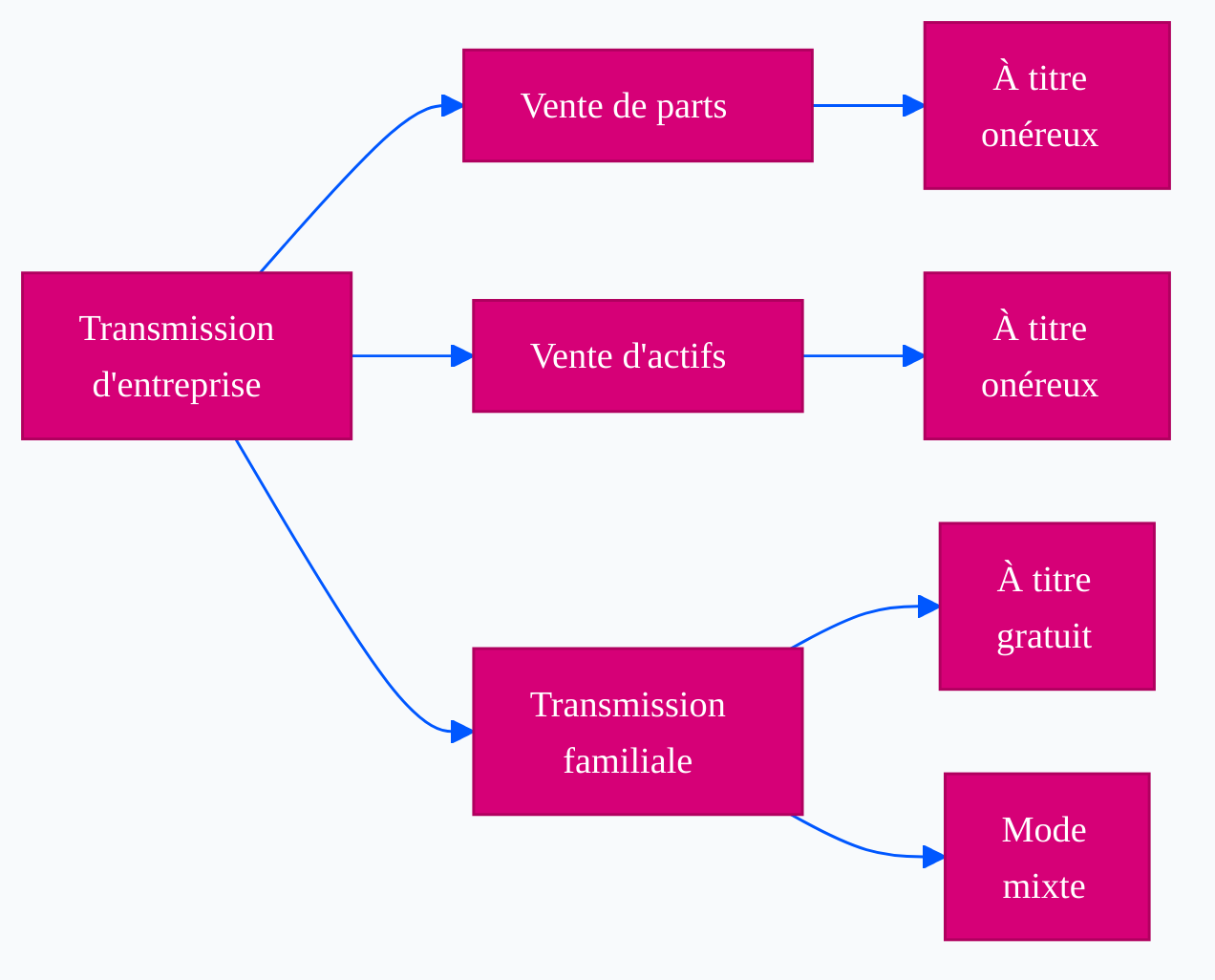
According to FER Geneva, transmission can take three distinct forms:
- Sale of shares (share deal): the seller transfers their participation in the company, which continues to exist unchanged. Main advantage: for a seller acting as a private individual, the capital gain on privately held shares is in principle exempt from federal income tax (Art. 16 para. 3 FITA).
- Sale of assets and liabilities (asset deal): the buyer acquires the constituent elements of the business, not the legal structure itself. This is the most frequent form for sole proprietorships and small retail businesses. It does however trigger the taxation of hidden reserves for the seller.
- Partial sale of activities: a branch or division is transferred while the parent company remains for the rest. Useful when the seller wants to retain a strategic part of their business.
On top of these forms come the modes of transmission: for consideration (classic sale), free of charge (donation, frequent in family successions), or mixed. Each combination has distinct tax and legal implications that must be arbitrated early in the process.
Key takeaway: the Official Portal for Swiss SMEs highlights a point often underestimated: a well-conducted transmission takes an average of three to five years from start to finish. Starting early is not an option, it is a condition of success.
Step 1: Business valuation and preparation
Before looking for a buyer, your company must be ready to be examined closely. Very closely. A serious buyer will scrutinise your accounts, review your contracts and probe your teams. Best that what they find works in your favour.
Financial audit
The financial audit aims to build a full picture of the company's health: revenue over three to five years, cost structure, bank debt, off-balance-sheet commitments, liquidity, equity. The point is not to embellish the picture, it is to make it readable and credible to an external eye.
On the valuation side, three classic approaches coexist in Swiss practice:
- EBITDA multiples method: the most used for SMEs. Ranges vary strongly by sector. Typically 3 to 5 × EBITDA in hospitality and small retail, 4 to 6 × in classic B2B services, 5 to 8 × in specialised industrials with technical know-how, and higher multiples in tech or highly recurrent franchise models.
- Discounted cash flow (DCF) method: adapted to companies with a solid forward trajectory over five to ten years. More technical, it requires rigorous projections and a discount rate aligned with the risk profile.
- Asset-based method: relevant for asset-heavy companies (operating real estate, machines, inventory). It undervalues low-capital, high-profitability activities.
A concrete example: a Romandie craft SME generating CHF 2 million in revenue with a recurring EBITDA of CHF 400,000 will typically be valued between CHF 1.6 and 2.4 million (4 to 6 × EBITDA range), excluding real estate. To go deeper on these methods and avoid the common traps of over or under-valuation, see our dedicated guide on how to value a business in Switzerland.
A buyer who discovers surprises after signing can turn against you via asset and liability warranty clauses. Transparency from the start protects both parties and drastically limits the risk of post-closing litigation.
Strategic diagnosis
An honest SWOT forces you to look at what the successor actually takes over. Strengths: loyal clientele, strategic location, rare know-how. Weaknesses: dependency on your personal network, ageing equipment, a lease expiring in eighteen months, a client worth 40 % of revenue.
This diagnosis serves two purposes: setting a fair price that is defensible in negotiation, and identifying the issues to fix before going to market. A known, documented weakness is negotiable. A weakness discovered during due diligence gets expensive quickly.
Making the business transmission-ready
CVCI describes this step as bringing the company into a state of "transmission-readiness": restructuring what can be, eliminating chronic loss sources, formalising processes that rest solely on the founder's memory, securing strategic contracts.
Concretely, this means documenting key operational procedures, transferring sensitive client relationships to other team members, clarifying intellectual property (trademarks, software, patents), separating operating real estate into a dedicated entity when relevant, and cleaning up shareholder current accounts.
A company whose client book lives only in the owner's head is structurally worth less than one with documented procedures and a team capable of functioning without the founder. If you plan to sell your business in Switzerland, this upstream preparation makes all the difference on final price and transaction speed.
Consult the CVCI vade-mecum on business transmission for a detailed analysis grid of this preparation phase.

Step 2: Tax planning and strategy
Swiss transmission taxation is, compared to neighbouring countries, remarkably favourable. But favourable does not mean automatic: poor structuring can turn a potential advantage into an unexpected bill, notably via the indirect partial liquidation trap.
The Swiss tax advantage in numbers
In France, gift and inheritance taxes (donation or succession) can reach 45 %. In Switzerland, these duties are set by cantons and remain very low, or even non-existent for direct-line transmissions. This is the case in Geneva, Vaud, Valais, Fribourg, Neuchâtel, Berne, Zurich and Basel-City for direct descendants (children, grandchildren). The gap is substantial, making family transmission particularly attractive on Swiss territory.
For arm's-length transfers, the principle is even more favourable on the seller's side as an individual: the capital gain realised on the sale of shares held in private wealth is in principle exempt from federal income tax (Art. 16 para. 3 FITA) and cantonal income tax. This is one of the major structural advantages of the Swiss tax system compared to most OECD countries.
| Criterion | Switzerland | France |
|---|---|---|
| Gift/inheritance duties (direct line) | Very low to non-existent (cantonal) | Up to 45 % |
| Capital gains tax (individual, private wealth) | Exempt (Art. 16 para. 3 FITA) | Taxed (with allowances) |
| Cantonal steering | Yes, strong variability across 26 cantons | No, unified national regime |
The sensitive point: hidden reserves
For sole proprietorships and partnerships (simple, general or limited partnerships), asset transfer triggers taxation of hidden reserves (Art. 18 FITA), i.e. the difference between book value and fair value of the assets. On an activity run for twenty or thirty years, this gap can represent several hundred thousand Swiss francs, and therefore a significant tax burden.
Three main strategies mitigate this burden, all requiring anticipation:
- Conversion into LLC or stock company under Art. 19 FITA: restructuring a sole proprietorship into a capital company can be carried out tax-free, provided book values are carried over and the resulting participation is held for at least five years. Once the capital company is in place, the subsequent sale of shares falls under the exempt regime for private capital gains.
- Separation of real estate holdings: moving operating real estate into a dedicated entity before the sale allows the seller to retain a tangible asset producing rental income, and avoids its hidden valuation being hit by the asset deal.
- Early dividend distribution: for an LLC or stock company with excess liquidity, distributing dividends several years before the sale reduces the transferable substance and avoids the buyer financing this liquidity on credit. Caution: if the distribution is concentrated within the five years preceding the sale, it can fall under indirect partial liquidation (see below).
These operations take time, often three to five years, which confirms why anticipation is rule number one. The Federal Tax Administration (estv.admin.ch) publishes the applicable circulars in case of doubt.
The indirect partial liquidation trap (Art. 20a FITA)
This is the most frequently misunderstood tax point, and the one that can cost the seller most five years after the sale. Indirect partial liquidation (IPL) aims to prevent transforming a dividend distribution (taxable as income) into a capital gain (exempt) by selling to a buyer holding company.
Four cumulative conditions trigger the tax reclassification:
- Sale of a participation of at least 20 % of the share capital of a corporation or cooperative;
- The participation sold is held in the seller's private wealth, and moves to the acquirer's business assets (typically a holding);
- Distribution within five years after the sale of substance non-essential to operations, existing at the time of sale and distributable under commercial law (free reserves, excess liquidity);
- Participation of the seller in the operation (information on distributable substance, contractual agreement, etc.).
If the four conditions are met, the capital gain initially exempt is reclassified as taxable income, and a tax reassessment procedure can happen up to five years after the transaction. The standard contractual safeguard is to include in the sale agreement a clause by which the buyer commits not to distribute pre-existing substance for five years, under threat of indemnifying the seller.
Family succession or external buyer: which path to choose?
This is often the first question a seller asks. And the honest answer is: neither is better than the other. They address different situations, and Swiss trends over the past twenty years show a clear shift toward external transmission.
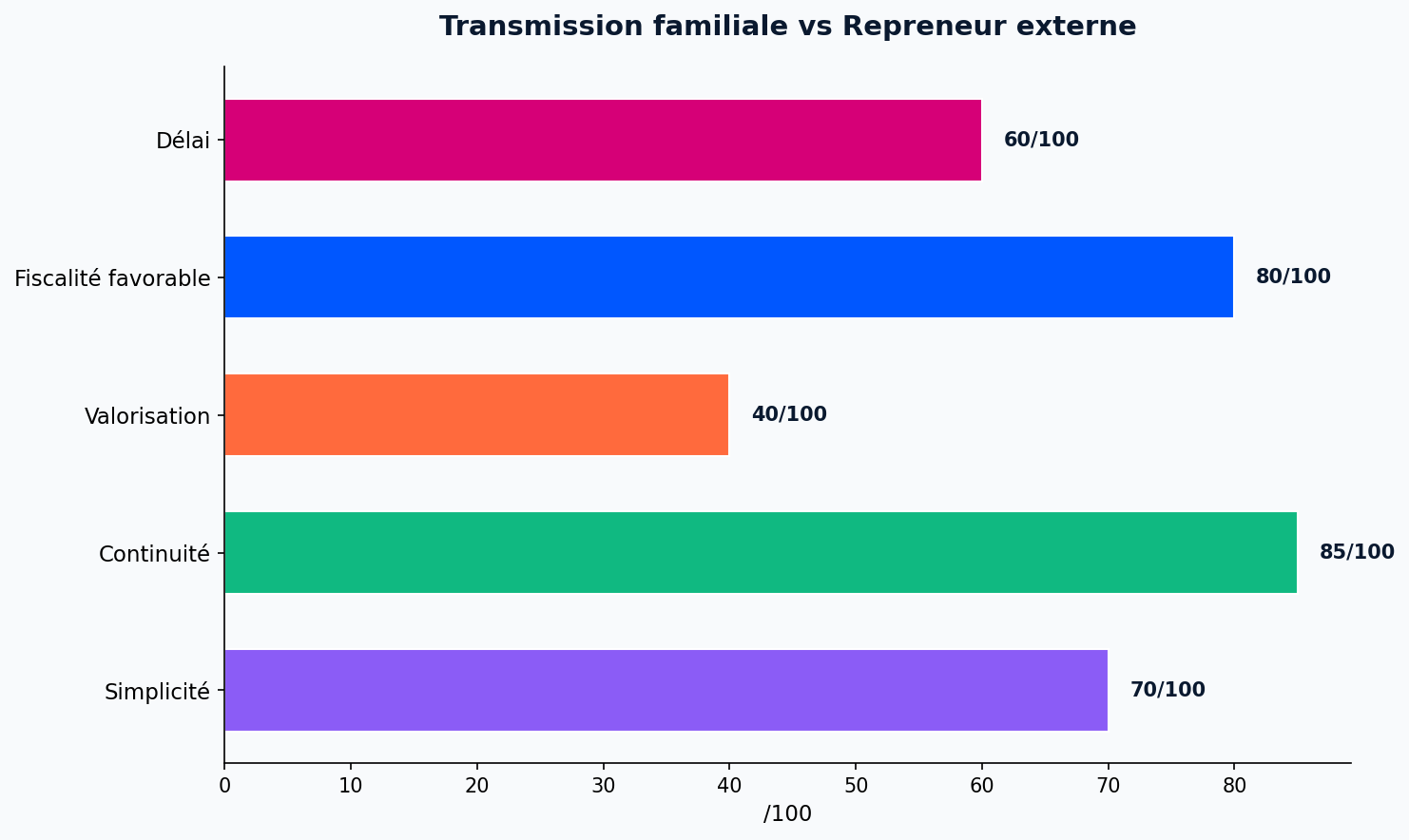
According to the recurring Credit Suisse studies on SME succession in Switzerland, the share of family transmissions has declined over time: from majority status twenty years ago, it now accounts for around 40 % of cases, in favour of external takeovers (35 to 40 %) and MBO/MBI by employees or external executives (15 to 20 %). This shift reflects founder ageing, children choosing other careers, and the professionalisation of the succession market.
Family transmission
It offers clear advantages: pre-existing knowledge of the company, cultural continuity with teams and clientele, and on the tax front, exemption or quasi-exemption from gift and inheritance duties in direct line in most cantons. But it requires that the designated heir has the capacity, motivation and legitimacy in the eyes of the teams and partners.
Too often, family transmission is decided by default, without the heir truly saying yes. The result: a business taken over reluctantly, that falters within two or three years. A difficult conversation today beats a silent failure tomorrow. Donation-partage with a cash balance to non-succeeding siblings is a common contractual tool to preserve family equity without diluting leadership.
The external buyer
Acquisition by a third party (an individual in reconversion, an experienced entrepreneur, an industrial group) often delivers a higher valuation and a clean break. The process is more formalised: NDA, letter of intent, full due diligence, negotiation of asset and liability warranties, non-compete clauses.
Integrating the buyer early in the process is decisive. A handover period of six to twelve months, during which the former owner remains as an advisor, significantly increases the chances of success. For the seller, this is also the most favourable tax regime when shares are held in private wealth, subject to not falling into the IPL trap outlined above.
Employee takeover (MBO)
Often underestimated, internal takeover (MBO, Management Buy-Out) has a major advantage: the buyer already knows the company, the clients, the teams and the culture. The transition is smoother, the operational risk lower. In hospitality and catering notably, MBOs are frequent: a head chef or sous-chef takes over their employer's establishment after several years of collaboration. Our guide on taking over a restaurant in Switzerland details the specifics of this sector-specific form of reprise.
The main obstacle remains financing. Executive buyers rarely have the capital to fund the entire transaction. Swiss banks (UBS, ZKB, Raiffeisen, BCV, BCGE) accept to support these files with a classic mix: 20 to 30 % personal equity, 40 to 50 % bank credit secured by assets and future cash flows, and an earn-out or vendor credit for the balance. A solid business plan and the backing of a reputable fiduciary are essential to secure bank approval.
Legal and contractual aspects
Business transmission is first and foremost a legal act. A poorly drafted contract, a forgotten clause, an unchecked supplier agreement: sources of post-closing litigation are numerous and are often settled before cantonal civil courts, with significant delays and costs.
The sale agreements
Whether it is a share transfer or an asset sale, the contract must cover several critical points:
- Precise definition of what is transferred (assets, contracts, trademarks, client files, databases)
- Asset and liability warranties (reps & warranties) and their duration, typically 18 to 36 months
- Suspensive conditions (financing, landlord consent, cantonal regulatory authorisation)
- Seller non-compete clauses, bounded in time (two to three years) and space (canton, linguistic region)
- Terms of any earn-out and precise definition of the retained indicators
- Anti-IPL clause for share deals (five-year commitment not to distribute pre-existing substance)
Two articles of the Code of Obligations particularly structure the transaction:
- Art. 181 CO (Assignment of assets or a business): the acquirer becomes liable for debts upon notification to creditors or publication. The seller remains jointly and severally liable with the buyer for three years, which protects creditors and creates a residual risk for the seller. For entities registered in the commercial register, the Merger Act of 3 October 2003 applies instead, with a simplified asset transfer regime.
- Art. 333 CO (Transfer of employment contracts): upon business transfer, employment contracts are automatically transferred to the buyer with all their rights and obligations (seniority, leave, vested benefits). Employees have a right of refusal, but the termination then takes effect at the legal term. Transparent communication to teams, ideally coordinated with signing, is essential.
These elements are not improvised. A lawyer specialised in Swiss business law, ideally with SME M&A expertise, is indispensable at this stage. The cost of serious legal support (CHF 10,000 to 40,000 depending on complexity) is negligible compared to the risk of a botched contract.
Checking existing contracts
Before signing anything, verify the transferability of the main contracts: commercial lease, supplier agreements, software licences, key-client contracts, cantonal operating permits. A non-transferable lease can block an entire transaction. A supplier contract with a change-of-control clause can jeopardise a large part of revenue.
FER Geneva recommends mapping all contractual commitments of the company before entering into any negotiation with a buyer. This map, attached to the presentation dossier, reassures the buyer and accelerates due diligence.
Negotiation and closing: what plays out in the final stretch
Due diligence is complete. The price is almost set. And yet, it is often in this final phase that transactions derail, sometimes on details that could have been anticipated months earlier.
Financial transparency as a lever
A seller who anticipates embarrassing questions and answers them before they are asked gains credibility. If your N-1 result is below the five-year average, explain why. If one client represents 40 % of revenue, show the multi-year contract that secures the relationship. If a labour-court dispute is pending, document it and quantify the risk.
A surprised buyer lowers their offer. An informed buyer maintains theirs. An organised data room (financial, legal, HR, commercial, operational) is now standard even for SMEs, and a simple structured Google Drive or Dropbox folder suffices for smaller transactions.
Separating the business from personal wealth
A point often overlooked: the mix between professional and personal wealth. Company vehicle used for private purposes, premises owned by the executive and rented to the company on informal terms, loans between shareholder accounts, life insurance subscribed on the company's name benefiting the family.
These situations must be clarified and documented well before the sale. What is unclear is always negotiated downwards. A seller well supported by their fiduciary will have cleaned up these points at least eighteen months before going to market.

Transition and post-closing follow-up
Contract signing is not the end of the process. It is the beginning of a phase often neglected, yet one that conditions long-term success of the takeover.
Supporting the successor
The former owner can stay on for a defined period, typically six to twelve months depending on the complexity of the activity, as advisor, consultant or part-time employee. This presence reassures clients, suppliers and employees during the critical window. It also allows transmission of implicit know-how: the loyal client's habits, the supplier who prefers a Tuesday morning call, the service provider to avoid, the sensitive legal file sleeping in a drawer.
This period must be time-bounded and formalised in the contract, with a monthly retainer or hourly fee. An open-ended presence by the former owner can become a brake on the successor's autonomy and the credibility of the new governance with teams.
Performance monitoring
Some transmissions include an earn-out clause: part of the sale price (typically 10 to 30 %) is conditional on the company's performance over one or two years after the sale. The retained indicators are most often revenue, EBITDA or net income, with a trigger threshold and a cap.
This mechanism aligns seller and buyer interests, especially when part of the value relies on continuity of client relationships held by the seller. It however requires a very precise definition of the retained indicators and accounting rules (restatements, exclusions, EBITDA definition) to avoid disputes at term. For transactions above CHF 1 million, dedicated legal drafting of this clause is inexpensive insurance.
Resources and professional support
Wondering where to start concretely? Business transmission is too complex a project to be conducted alone. The good news is that the Swiss ecosystem offers serious resources for every step, from initial diagnosis to connecting with qualified buyers.
The experts to call on
Each phase of the process calls for a different profile:
- Chartered accountant or fiduciary: for financial audit, valuation and structural tax arbitrage. Indicative budget: CHF 5,000 to 20,000 depending on company size.
- Business lawyer with M&A expertise: for contract drafting, verification of commitments and legal structuring. Indicative budget: CHF 10,000 to 40,000.
- Tax advisor: to optimise structuring before the sale, notably on IPL, conversion into LLC/SA, real estate separation. Sometimes integrated into the fiduciary.
- Transmission consultant or M&A broker: to steer the overall process, draft the information memorandum, find qualified buyers and lead the negotiation. Typical compensation: monthly retainer (CHF 2,000 to 5,000) plus success fee of 3 to 8 % of the sale price for SMEs.
Practical advice: avoid using a single interlocutor for everything. The accountant who values the company should not be the one negotiating the price with the buyer. Conflicts of interest are real in this domain, and the Swiss Chamber of Fiduciaries explicitly recommends this separation.
Support organisations in Switzerland
Several structures offer neutral and often free support for the initial approach:
- Federal portal kmu.admin.ch: the official portal for Swiss SMEs provides structured information, checklists and qualified contacts per canton.
- Cantonal chambers of commerce: CVCI (Vaud), CCIG (Geneva), CNCI (Neuchâtel), HIV ZH (Zurich), Valais Chamber of Commerce regularly organise seminars and provide first-level support.
- Relève PME: platform run by the Swiss Union of Crafts and SMEs (usam-sgv.ch) dedicated specifically to SME transmission.
- SME-specialised M&A brokers: Business Broker AG, Success & Career, Capital Transmission and other independent houses cover transactions from CHF 500,000 to 20 million with full-service support.
- Sector employer associations: GastroSuisse for hospitality, Swissmem for MEM industry, ASIP for healthcare, etc. They publish guides and valuation statistics by sector.
To explore the different strategies available according to your seller profile, Vermögenszentrum offers a comparative analysis of transmission options particularly useful in the initial reflection phase.
Finding a buyer: the available channels
Once the company is ready, you need to make it visible to the right profiles. Three channels stand out:
- The seller's personal network: professional contacts, sector associations, former employees, clients turned entrepreneurs. First channel, often under-used, but with a strong information-leak risk if poorly framed (systematic NDA).
- Specialised intermediaries: M&A brokers, lawyers and fiduciaries with buyer networks. Bespoke support, but costly (3 to 8 % of sale price commission). Relevant for companies above CHF 2 million valuation.
- Direct-match platforms: transparency, national reach, access to diverse buyer profiles. PME-Market lists several hundred active listings across the 26 cantons, covering very diverse SME and retail profiles for takeover, with a flat subscription from CHF 59/month and zero transaction commission.
If you are on the buyer side, our guide to buying a business in Switzerland details the acquisition-specific steps, from bank financing to due diligence.
How long should you really plan for?
The short answer: more than you think. The honest answer: it fully depends on your starting situation and the degree of preparation of your company.

| Phase | Indicative duration | Main deliverables |
|---|---|---|
| Preparation and transmission-readiness | 12 to 24 months | Financial audit, restructuring, process documentation |
| Tax and legal planning | 6 to 18 months (in parallel) | Holding structuring, Art. 19 FITA, real estate separation |
| Buyer search and negotiation | 6 to 18 months | Memorandum, NDA, LOI, due diligence, signed contract |
| Post-closing transition | 6 to 12 months | Know-how handover, earn-out, warranty closure |
All in, a well-conducted process spans two to five years depending on company complexity and initial preparation level. Starting at 60 to sell at 65 is doable. Starting at 63 hoping to sign at 65 is risky: the market does not always align with your personal calendar, and some phases (transmission-readiness, tax optimisation) cannot be compressed without loss of value.
The most robust lesson shared by Swiss fiduciaries and M&A brokers is simple: successful transmissions are those planned five years ahead, not those decided in the urgency of a health event or an unexpected buyer approach.
Frequently asked questions
How long does a business transmission take in Switzerland?
According to the official kmu.admin.ch portal, a well-conducted transmission process takes two to five years. Plan 12 to 24 months for preparation and making the business transmission-ready, 6 to 18 months for tax and legal planning run in parallel, 6 to 18 months for buyer search and negotiation, and 6 to 12 months for post-signature transition. Starting early is rule number one.
What is the tax framework for a business transmission in Switzerland?
Switzerland stands out with a very favourable tax framework. For a seller as an individual holding shares in private wealth, the capital gain is in principle exempt from federal income tax (Art. 16 para. 3 FITA). Gift and inheritance duties are set by cantons and remain very low, even non-existent for direct-line transmissions (Geneva, Vaud, Zurich, Berne, Fribourg notably). The main pitfall concerns indirect partial liquidation (Art. 20a FITA): if the buyer distributes pre-existing substance within five years following the sale, the gain may be reclassified as taxable income.
Is it better to transmit the business within the family or to an external buyer?
Both options are viable, depending on context. Credit Suisse studies show family transmission now accounts for around 40 % of cases in Switzerland, versus 35 to 40 % for external takeovers and 15 to 20 % for MBOs. Family transmission offers cultural continuity and favourable taxation, but requires the heir to genuinely have the capacity and motivation. External takeover often delivers a higher valuation and a clean break. Employee MBO ensures a smooth transition thanks to pre-existing knowledge of the company.
Which experts should be called on for a business transmission in Switzerland?
Transmission requires several complementary profiles: a chartered accountant or fiduciary for financial audit and valuation (CHF 5,000 to 20,000), a business lawyer with M&A expertise for contracts and warranties (CHF 10,000 to 40,000), a tax advisor for anti-IPL structuring and Art. 19 FITA arbitrage, and an M&A broker or transmission consultant to steer the overall process (3 to 8 % commission on sale price). Avoid delegating the whole file to a single interlocutor: the Swiss Chamber of Fiduciaries recommends this separation to prevent conflicts of interest.
What is making a business transmission-ready?
Making a business transmission-ready refers to the actions carried out before going to market to make the company more attractive and safer for a buyer. It includes restructuring unprofitable activities, formalising processes that rest solely on the founder's memory, clarifying supplier contracts and the commercial lease, cleanly separating personal and professional wealth, and cleaning up shareholder current accounts. A well-prepared company sells faster and at a better price.
How many Swiss companies are concerned by a transmission in the coming years?
According to converging studies from Credit Suisse and Bisnode D&B, more than 75,000 Swiss SMEs will be concerned by a transmission by 2031, approximately one SME in five. These transmissions involve nearly 500,000 jobs, making it a major economic stake. The phenomenon particularly affects sole proprietorships and baby-boomer generation founders nearing retirement.
How do you find a buyer for your business in Switzerland?
Several channels exist. The seller's personal network (professional contacts, sector associations) is the first channel, often under-used. Specialised intermediaries such as Business Broker AG, Success & Career or fiduciaries with networks form a second channel, relevant for companies above CHF 2 million. Direct-match platforms like PME-Market allow reaching a broad pool of buyers nationwide with transparency on criteria. Cantonal chambers of commerce (CVCI, CCIG, HIV ZH) and the Relève PME platform run by the Swiss Union of Crafts and SMEs also offer neutral resources and introductions.
What is an earn-out clause in a business transmission?
An earn-out clause is a contractual mechanism by which part of the sale price (typically 10 to 30 %) is conditional on the company's future performance, generally over one to two years after closing. The retained indicators are most often revenue, EBITDA or net income, with a trigger threshold and a cap. This mechanism aligns seller and buyer interests, but requires a very precise definition of accounting rules (restatements, exclusions, EBITDA definition) to avoid disputes.
What is indirect partial liquidation and how do you avoid it?
Indirect partial liquidation (IPL, Art. 20a FITA) reclassifies as taxable income a capital gain that would normally be exempt, when four cumulative conditions are met: sale of a participation of at least 20 % held in private wealth, transfer to the acquirer's business assets (typically a holding), distribution within five years after the sale of pre-existing substance not essential to operations, and participation of the seller in the operation. The standard contractual safeguard is to include in the sale agreement a clause by which the buyer commits not to distribute this pre-existing substance for five years, under threat of indemnifying the seller.
Related articles

Taking Over a Restaurant in Switzerland: The Complete Guide
Complete guide to taking over a restaurant in Switzerland: financial analysis, due diligence, financing, legal requirements and post-takeover management.

Buying a Business in Switzerland: Complete Guide for Entrepreneurs
Step-by-step guide to acquiring a Swiss business: platforms, due diligence, financing, cantonal specifics. Everything you need to know to buy a business in Switzerland methodically.

Selling Your Business in Switzerland: Complete Guide 2026
Complete 2026 guide to selling your business in Switzerland: valuation methods, legal aspects, tax implications, finding buyers, and avoiding costly mistakes.