Buying a Business in Switzerland: Complete Guide for Entrepreneurs
Thinking about taking over a business in Switzerland? You are not alone: in 2024, 519 SME transactions were recorded on Swiss soil (source Berney Associés). Behind that number lies a concrete reality: every year, thousands of buyers, often mid-career executives in transition or seasoned entrepreneurs, take over a restaurant, a pharmacy, a salon, a craft workshop or a service SME.
Buying rather than building from scratch means starting with an established customer base, proven processes and a ready-made reputation. But the Swiss market has its own rules, pitfalls and specifics. This guide walks you through the journey from defining your criteria to closing the deal, with real price ranges, named banks and verified timelines. No unnecessary jargon.

What are the key steps to buy a business in Switzerland?
Buying a business happens in six main steps: define your criteria, search for opportunities, analyse the target business, assess its value, secure financing, then negotiate and sign. A structured transaction takes on average 6 to 12 months according to UBS, from first contact to effective share or asset transfer. Buyers who try to move faster typically get burned during due diligence.

Define your criteria before you search
This is the step everyone rushes through. Buyers set off looking for a business without having defined what they actually want, and they end up falling in love with a file that does not match their profile.
Ask yourself these questions upfront:
- Sector: which skills can you transfer? A commercial executive can take over a specialist retailer, an engineer can take over a craft workshop. A buyer with no operational background in hospitality or food service who buys a restaurant starts with a serious handicap.
- Size: a reliable rule of thumb is personal equity × 3 to 4. With 200,000 CHF of equity, target an acquisition price between 600,000 and 800,000 CHF, not more.
- Canton: corporate taxation, sector permits and negotiation culture vary significantly. Vaud, Fribourg and Lucerne tend to be gentler than Geneva or Zurich on corporate tax.
- Profitability target: a normalised net profit of 80,000 to 120,000 CHF per year is a minimum to repay a bank loan, cover a decent salary and absorb a shock.
These answers become your search filter. Without them, you waste months reviewing files that do not fit you.
Search for opportunities: on-market and off-market
The Swiss business transfer market splits into two worlds. The on-market world gathers listings visible on specialist platforms. The off-market world, estimated at close to half of Swiss SME transactions, plays out discreetly between professionals, via fiduciaries, corporate lawyers and M&A advisors, without ever appearing publicly.
To access both, run a dual strategy: weekly monitoring of specialist platforms and active use of your local network (sector associations, fiduciaries, cantonal chambers of commerce). Fiduciaries often know owners who are thinking of selling without having formalised it yet.
Where to find businesses for sale in Switzerland?
Sources are plenty, but their quality varies. Here is how to use them wisely.
Specialist online platforms
This is the natural starting point. Platforms dedicated to the Swiss market publish listings with the essential data: turnover, net profit, monthly rent, lease type. Some, such as PME-Market, allow direct contact with the seller without an intermediary, which speeds up initial discussions and avoids retrocession commissions.
Other platforms such as Capital First also publish listings with detailed financials. The advantage of a Swiss-focused platform: files are filtered by sector, canton and price range. You are not browsing generic ads, you are accessing businesses actually available for transfer.
In practice, quality listings rarely stay more than 3 to 6 months online before finding a buyer or being withdrawn. Set up alerts by criteria (canton, sector, price range) and react within 48 hours on a file that fits your profile. If you are targeting a restaurant first, read our dedicated guide on how to take over a restaurant in Switzerland before the first contact.
Business consultants and specialist brokers
For complex or larger transactions, a transactions consultant can be valuable. They access the off-market and can show you opportunities before publication. The trade-off: their seller-side mandate translates into a commission of 3 to 8% of the sale price, which can affect their neutrality.
Distinguish between a consultant mandated by the seller (broker) and an M&A advisor you hire yourself (buy-side advisor). They are not the same, and that radically changes the advice you receive.
Professional networking
Too often underestimated. Switzerland has a dense economic fabric where relationships matter. Letting your network know you are looking to take over a business in a specific sector can trigger unexpected opportunities. Cantonal fiduciaries often know owners considering selling without having formalised it yet, especially in sectors with a high share of 55-plus owner-managers (crafts, neighbourhood retail, independent hospitality).
How do you analyse a business before committing?
The rigorous analysis, known as due diligence, is the phase where you turn an intuition into certainty, or a justified refusal. It is also the phase where gaps appear between the seller's commercial pitch and the economic reality of the accounts.
Reviewing the financial statements
Always request the three most recent full accounting years (balance sheets, P&L, notes), plus the interim situation for the current year. What to look for:
- Turnover trend: growth, stagnation or decline? A decline above 10% per year over two consecutive years is a red flag.
- Gross margin and its trend. Indicative sector benchmarks: restaurants 60 to 70%, food retail 25 to 35%, B2B services 40 to 55%, crafts 35 to 50%.
- Real net profit, adjusted for exceptional items and the owner's personal expenses (car, phone, travel, sometimes spouse's salary).
- Operating cash flows. A business can show an accounting profit and generate very little cash.
Also inspect the balance sheet: inventory levels, receivables (ageing?), payables, cash position. These indicators of day-to-day operational health are often more revealing than the net profit line.
Swiss-specific red flags: late AVS / LPP social contributions (visible as social liabilities), partially contested VAT returns, owner's personal expenses booked as operating costs, spouse's remuneration unjustified by a real activity. Always request a recent OAI statement and a tax authority statement.
Checking contracts and licences
A business is also a bundle of rights and obligations. Check systematically:
- The commercial lease: remaining term, renewal conditions, assignability clause to the buyer (often subject to the landlord's consent under art. 263 CO).
- Specific licences: alcohol and tobacco patents, cantonal health permit, cantonal restaurant or beverage licence, pharmacy or medical practice approvals.
- Supplier contracts with change-of-control clauses (common in franchise, exclusive distribution, licensing).
- Employment contracts of the staff being taken over and the internal regulations.
The commercial lease is often the most critical item. A business with a lease expiring within 18 months and no guarantee of renewal is structurally worth 20 to 40% less than an equivalent business with a 5-year renewable lease.
Assets, liabilities and hidden liabilities
Beyond the official balance sheet, look for liabilities that do not appear: ongoing litigation, overdue social contributions, tax debts, guarantees given to third parties, off-balance-sheet commitments. In Switzerland, buying a sole proprietorship or a partnership triggers a transfer of the former operator's liabilities (art. 181 CO), unlike buying shares in a Sàrl/GmbH or SA/AG, which legally isolates the buyer. The deal structure (asset deal vs share deal) therefore changes everything: whenever possible, prefer an asset deal when taking over a sole proprietorship.
Negotiation and signing: do not rush this phase
You have found the right file, the analysis is conclusive. Now comes the negotiation. This is often where buyers make their structural mistakes: rushing out of fear of losing the opportunity, or getting stuck in endless negotiations that scare the seller away.
Clarify every term before signing
Price is only one element of the contract. Payment terms can be just as important. A seller who accepts deferred payment or an earn-out (15 to 30% of the price indexed to the business results over 2 to 3 years post-closing) can justify a higher headline price.
Discuss clearly:
- The transition period: 3 to 6 months is the norm for a neighbourhood business, 6 to 12 months for an SME with complex client relationships. The seller stays available, paid or not, depending on the agreement.
- The non-compete clause: 2 to 3 years, a cantonal or radius-based geographic perimeter, a precise sector. Swiss courts void clauses deemed too broad.
- Staff treatment: in case of business transfer, employment contracts are transferred by operation of law (art. 333 CO). You cannot cherry-pick.
- Representations and warranties: duration (12 to 24 months standard), cap, deductible, potential escrow mechanism.
If you also consider selling a business later on, understanding these clauses from the buyer side will give you a valuable edge when the time comes. And for a wider view on business succession in Switzerland, our dedicated guide covers the tax and estate aspects that this buyer guide only touches briefly.
Specialist lawyer: a justified expense
In Switzerland, commercial law, the Code of Obligations and company law vary depending on the legal structure involved. Hiring a lawyer specialised in business transactions is not a luxury reserved for large deals: it is an indispensable protection regardless of the size of the business being taken over.
Realistic market range for an SME deal between 400,000 and 1,000,000 CHF: 15,000 to 40,000 CHF excluding VAT for a full engagement (NDA, letter of intent, sale agreement, closing). Standard hourly rate for business lawyers: 300 to 600 CHF per hour depending on seniority. A poorly drafted contract can expose you to six-figure disputes after closing. The expense is an insurance, not a cost.
How do you finance the purchase of a business in Switzerland?
Financing conditions everything. Without a clear solution, even the best file stays out of reach. The good news: with the SNB policy rate kept at 0% since June 2025, SME credit conditions are historically favourable. Swiss banks regularly finance viable business takeovers, provided the file is rock-solid.
Bank loan
This is the classic lever. Banks assess repayment capacity based on the cash flow generated by the business, not just on your personal situation. A business whose cash flow comfortably covers the repayment schedule (DSCR ≥ 1.3) will be financed without major difficulty.
Prepare a complete file: post-acquisition business plan, 3-year cash flow projection, proof of equity, detailed professional CV. The cantonal banks (BCV for Vaud, BCGE for Geneva, BCVs for Valais, BCF for Fribourg, ZKB for Zurich) are generally faster and more flexible on local files than the major national banks, because they know the cantonal economy and accept marginal risk on regional SMEs.
Indicative rates observed in 2025-2026 for SME credit with guarantees: 2.0 to 4.5% depending on the file, 5 to 10-year amortisation. For a deeper dive into financing and deal structuring, Growme.ch offers a detailed guide on business takeovers in French-speaking Switzerland.
Equity, seller financing and federal guarantee scheme
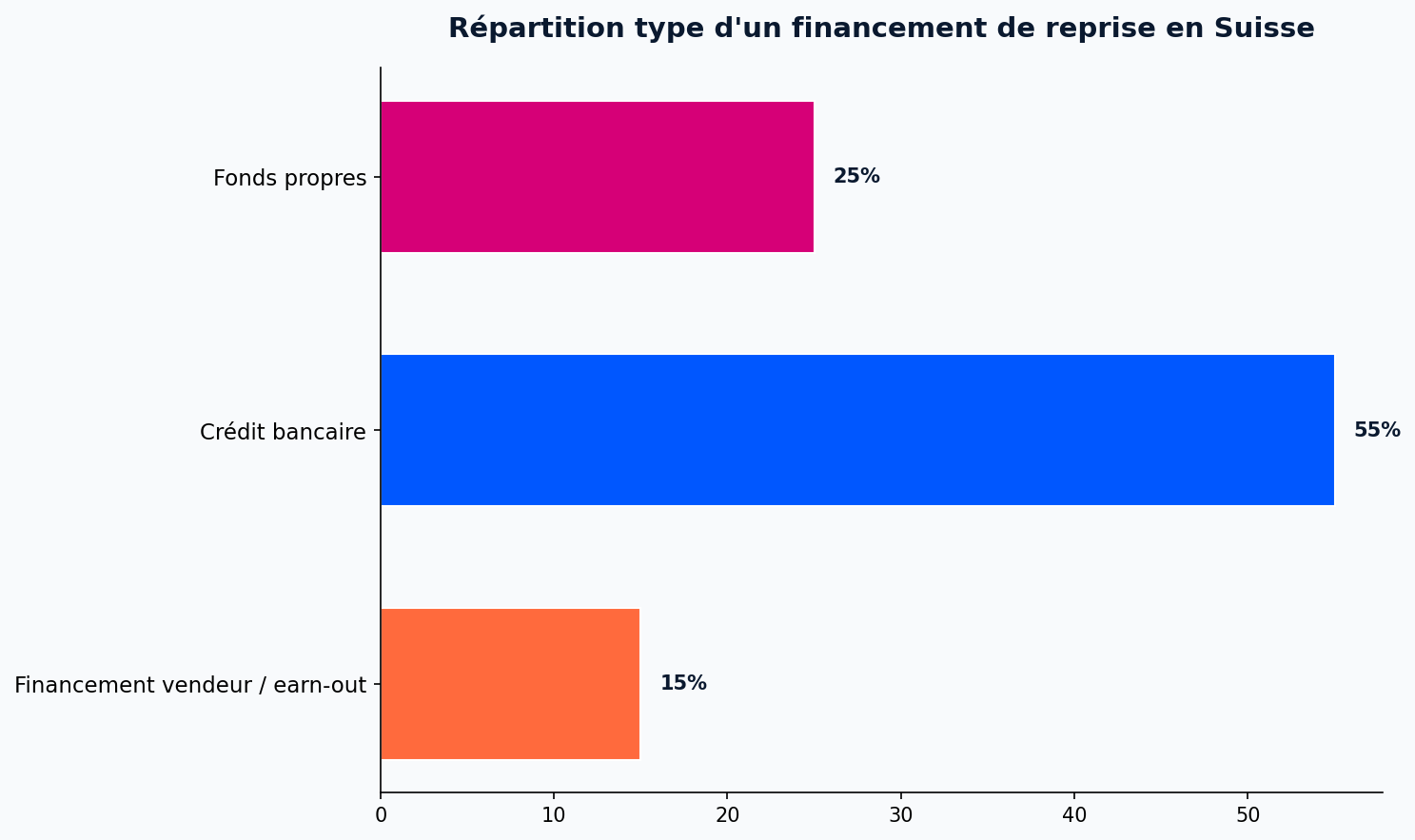
An equity contribution of 25 to 30% of the acquisition price is the Swiss market norm. Below 20%, few banks will follow. Above 40%, you over-finance and lose leverage.
Seller financing (seller loan) should be raised systematically during negotiation. Some sellers accept that part of the price be paid over 2 to 5 years, directly by the buyer. It is a strong signal of their confidence in what they are selling, and a powerful negotiation lever when they refuse.
Third lever, often overlooked: the federal SME guarantee scheme. The guarantee cooperatives (Cautionnement romand for French-speaking Switzerland, BG Mitte for German-speaking Switzerland and Ticino) can guarantee up to 1,000,000 CHF of SME bank credit with an annual risk commission of 1.25%. The Confederation covers 65% of the loss risk. In practice, this allows a buyer with limited equity to obtain credit the bank would have refused directly.
| Funding source | Typical share | Key conditions |
|---|---|---|
| Equity | 25-30% | Personal savings, partial withdrawal of 2nd pillar LPP under conditions |
| Bank loan | 50-60% | Sufficient cash flow (DSCR ≥ 1.3), strong business plan, collateral |
| Seller financing | 10-20% | Negotiated case by case, 2-5 years, signal of seller confidence |
| Federal guarantee | Up to 1M CHF | Commission 1.25% per year, Confederation covers 65% of the risk |
About the 2nd pillar: art. 5 para. 1 let. b LFLP allows the full withdrawal of vested benefits to finance the launch of a self-employed activity, provided the takeover is structured as a sole proprietorship or a partnership (GmbH and AG excluded), the buyer has obtained the AVS self-employed status, and the request is filed within 12 months. Spousal consent is required. Taxation is separate at 1/5 of the ordinary federal tax scale plus the cantonal pension scale. Review this option with your pension fund and a tax advisor before any decision.
What makes the Swiss market really different
The Swiss market for business transfers is specific. Ignoring these particularities when arriving from France, Germany or elsewhere means sailing without a compass.
Lease rights and valuation: distinct rules
In France, the "droit au bail" is a value in itself, negotiated and priced separately. In Switzerland, the logic is different: the commercial lease is a contract that is transferable (or not) depending on the terms negotiated with the landlord and article 263 CO. Its value is embedded in the overall goodwill valuation, not treated as a separate asset.
Swiss SME valuation typically follows an EBITDA or normalised net profit multiple logic. Market average observed on 2024 SME transactions: 6.5 times EBITDA, versus 9.5 times in the euro area (source FUSACQ). Indicative multiples by sector:
- Restaurants and bars: 3 to 5 × EBITDA, with a premium location premium
- Food retail and general retail: 4 to 6 × EBITDA
- B2B services and fiduciaries: 5 to 7 × EBITDA, owner dependency is penalising
- Crafts (carpentry, electrics, plumbing): 3 to 5 × EBITDA, technical assets are decisive
- Health and wellness (pharmacy, practice, beauty salon): 5 to 8 × EBITDA, loyal patient base is valued
A business well located in Geneva or Zurich will typically command 15 to 30% more than an equivalent business in rural Valais or Jura, even at identical turnover. Location, density of solvent population and local economic dynamics come at a price.
Cantonal differences: a frequently underestimated factor
Switzerland has 26 cantons and rules vary. Corporate taxation differs significantly: a taxable profit of 200,000 CHF bears roughly 14% of combined tax in Zug or Schwyz, versus 19% in Geneva or Basel-Stadt. Operating licences (alcohol, health, taxi) are issued at cantonal level, sometimes municipal. Notarial practice and the form of the sale contract also vary.
Even the local negotiation culture influences how a transaction unfolds. Working with an advisor who knows the cantonal economy and customs is not an advantage, it is a condition for success.
What types of businesses can you take over in Switzerland?
The market is broader than people think. On PME-Market, 17 types of businesses are listed across the entire country, with active listings in all 26 cantons. The most active sectors for takeovers (on-market and off-market combined) are hospitality, hair and beauty salons, building trades, neighbourhood food retail and medical or dental practices.
| Sector | Examples | Indicative price range |
|---|---|---|
| General retail | Bakery, grocery, bookshop, fashion | 150,000 - 800,000 CHF |
| Hospitality | Restaurant, café, bar, hotel, caterer | 200,000 - 1,500,000 CHF |
| B2B services | Agency, fiduciary, garage, printshop | 300,000 - 2,000,000 CHF |
| Crafts | Carpentry, electrics, plumbing, masonry | 250,000 - 1,200,000 CHF |
| Health and wellness | Pharmacy, medical practice, beauty salon, hairdresser | 150,000 - 3,000,000 CHF |
The hospitality sector deserves a special mention: it is one of the most active in Swiss takeovers, but also one of the most demanding. Tight margins, dense food safety regulations, high staff turnover, location dependency and heavy reliance on the operational manager. A thorough analysis of real profitability, adjusted for the owner's salary, is mandatory before any offer.
Coming from abroad and want to take over a business in Switzerland?
It is possible, but the administrative path deserves careful anticipation. EU/EFTA nationals benefit from the Agreement on the Free Movement of Persons (AFMP), which grants the right to pursue a self-employed activity in Switzerland under certain conditions.
Residence permit and right to work
The residence permit for self-employed individuals (B permit for more than one year, L permit for shorter stays) is issued at cantonal level, on the basis of art. 12 Annex I AFMP. Average processing time observed in French-speaking cantons: 6 to 8 weeks for a complete file, according to the Office of Population and Migration (OCPM Geneva, SPOP Vaud).
Documents to prepare: detailed business plan, proof of financial resources (bank statement), registration in the cantonal commercial register, active business address. The activity can generally start from the day the complete file is filed, except for regulated professions (health, legal, fiduciary) that require prior authorisation. For a complete overview of the formalities, this guide for French nationals covers the steps in detail.
Differences to anticipate between France and Switzerland
The Swiss market works differently from the French one, and not only on the administrative side:
- The culture of discretion: transactions are often discussed in confidence, without public display. A trusted local network is a valuable asset, more decisive than in France.
- Valuation of goodwill does not follow the same methods as in France. Swiss multiples are on average lower (6.5 vs 9.5 × EBITDA). Avoid projecting French reflexes onto Swiss realities.
- Taxation for the self-employed combines federal direct tax (IFD, progressive up to 11.5%), cantonal tax and municipal tax. The total ranges from 20 to 45% depending on the canton and municipality of residence and operation.
- Social contributions for the Swiss self-employed (AVS/AI/APG) represent about 10% of net income, with no mandatory unemployment insurance and optional 2nd pillar occupational pension.
Being supported by an expert who knows both contexts often makes the difference between a successful installation in 6 months and 18 months of exhausting procedures.
For non-EU/EFTA nationals: procedures are more complex and conditions for obtaining a self-employed work permit more restrictive (economic interest for Switzerland to demonstrate, cantonal quotas). The migration analysis must be conducted in parallel with the commercial analysis, not afterwards.
The serious buyer's checklist
Before making an offer, here is what you should have in hand or in progress:
- 3 most recent balance sheets and P&L statements, adjusted and commented
- Lease extract with transfer conditions (art. 263 CO)
- List of staff with seniority, salaries and contract terms
- Asset inventory (equipment, stocks, fixed assets, vehicles)
- List of ongoing contracts (suppliers, customers, providers, franchise)
- Licences and operating permits in force, with expiry dates
- Statements of no litigation, no tax, AVS or LPP arrears
- Target legal structure for the takeover (sole proprietorship, Sàrl, SA)
- Proof of bank financing capacity (pre-agreement or term sheet)
- Confirmation of AVS self-employed status, if LPP withdrawal is considered
This is not an exhaustive list, it is the minimum to enter serious negotiation. A specialist lawyer and a certified accountant will complement this analysis depending on the file, and their combined cost (15,000 to 40,000 CHF on an SME deal) remains trivial compared to the risk of a botched closing.
Frequently asked questions
How much personal equity is needed to buy a business in Switzerland?
Swiss banks expect an equity contribution of 25 to 30% of the acquisition price, with a market range observed between 20 and 40% depending on the file. Below 20%, few banks will follow. The contribution can be complemented by seller financing (deferred payment over 2 to 5 years), by the federal SME guarantee scheme (Cautionnement romand or BG Mitte, up to 1,000,000 CHF guaranteed, 1.25% annual commission) or, under strict conditions (art. 5 LFLP), by an early withdrawal of 2nd pillar vested benefits.
What is the average duration to complete a business takeover in Switzerland?
A structured business takeover transaction in Switzerland takes between 6 and 12 months according to UBS and the cantonal portal Relève PME, from first contact to effective transfer of shares. Simple files in general retail can close in 4 to 6 months, while takeovers in health, hospitality or sectors with heavy cantonal regulation (alcohol licences, health permits) often stretch to 9 to 12 months. For foreign nationals, the 6 to 8-week B permit processing time for the self-employed must be integrated into the overall schedule.
Can an EU citizen take over a business in Switzerland?
Yes. Thanks to the Agreement on the Free Movement of Persons (AFMP) between Switzerland and the European Union, an EU national can settle in Switzerland to pursue a self-employed activity. They must obtain a residence permit from the competent cantonal authorities (B or L permit depending on the planned duration), on the basis of art. 12 Annex I AFMP. Average processing time in French-speaking cantons: 6 to 8 weeks. Support from an expert familiar with both contexts is strongly recommended to avoid unnecessary delays.
Which valuation method applies to businesses in Switzerland?
In Switzerland, SMEs and businesses are typically valued based on an EBITDA multiple, with a market average observed around 6.5 times EBITDA on 2024 transactions (versus 9.5 times in the euro area). By sector: restaurants 3 to 5x, retail 4 to 6x, B2B services 5 to 7x, crafts 3 to 5x, health and wellness 5 to 8x. Unlike in France, the 'droit au bail' is not a separate asset but embedded in the overall goodwill valuation. A premium location in Geneva or Zurich can raise the valuation by 15 to 30% compared to an equivalent business in a rural area.
Is hiring a lawyer mandatory to buy a business in Switzerland?
It is not legally mandatory, but strongly recommended regardless of the transaction size. A lawyer specialised in Swiss commercial law checks the validity of contracts, drafts the representations and warranties clauses, verifies the lease transferability (art. 263 CO) and protects your interests in case of post-closing disputes. Market range observed for an SME deal between 400,000 and 1,000,000 CHF: 15,000 to 40,000 CHF excluding VAT for a full engagement (NDA, letter of intent, sale agreement, closing), standard hourly rate 300 to 600 CHF per hour.
Which sectors are most active for business takeovers in Switzerland?
Hospitality (restaurants, cafés, hotels), general retail (bakeries, grocery stores, neighbourhood shops), B2B services and building trades are the sectors most represented in Swiss takeover offers. The health and wellness sector (pharmacies, medical practices, beauty salons) is also active, but subject to specific cantonal approvals that lengthen transaction timelines. Hair and beauty salons and dental practices round out the most active sectors.
What is the difference between on-market and off-market?
The on-market gathers the business listings publicly visible on specialist platforms such as PME-Market or Capital First. The off-market gathers transactions concluded discreetly between professionals, via fiduciaries, corporate lawyers and M&A advisors, without public display. The Swiss off-market is estimated at close to half of SME transactions, which makes activating a local network (sector associations, cantonal chambers, fiduciaries) crucial, in parallel with monitoring the platforms.
Can I use my 2nd pillar to finance the purchase of a business?
Yes, under strict conditions set by art. 5 para. 1 let. b LFLP. The takeover must be structured as a sole proprietorship or a partnership (GmbH/Sàrl and AG/SA are excluded). You must obtain AVS self-employed status, file the request within 12 months and obtain spousal consent if married. No LPP buy-back within the previous 3 years. The withdrawal is taxed separately at 1/5 of the ordinary federal tax scale plus a cantonal pension scale. Review this option with your pension fund and a tax advisor before any decision.
What is the federal SME guarantee scheme and how do you obtain it?
The federal SME guarantee scheme allows Swiss SMEs to obtain a bank loan they would not have secured directly, thanks to a guarantee provided by a guarantee cooperative (Cautionnement romand for French-speaking Switzerland, BG Mitte for German-speaking Switzerland and Ticino). Maximum guarantee: 1,000,000 CHF per SME. Annual risk commission: 1.25% of the guaranteed amount. The Confederation covers 65% of the loss risk via SECO. To obtain it, submit your loan file to the cooperative after obtaining in-principle agreement from your bank. Typical processing time: 4 to 8 weeks.
Related articles
Taking Over a Restaurant in Switzerland: The Complete Guide
Complete guide to taking over a restaurant in Switzerland: financial analysis, due diligence, financing, legal requirements and post-takeover management.
Business Succession in Switzerland: Complete Guide to Selling or Acquiring an SME
Complete guide to business succession in Switzerland: valuation, taxation, legal aspects, and advice for selling or acquiring an SME.
Selling Your Business in Switzerland: Complete Guide 2026
Complete 2026 guide to selling your business in Switzerland: valuation methods, legal aspects, tax implications, finding buyers, and avoiding costly mistakes.