How to Value a Business in Switzerland: Methods, Examples & Steps

What is a business goodwill in Switzerland?
A business goodwill is far more than four walls and a cash register. It is the full set of elements that make your business work: customer contracts, the brand, the commercial lease, stocks, equipment, and the reputation built up year after year. Under Swiss law, this concept covers both tangible assets (equipment, furniture, stocks) and intangible assets (customer base, signage, know-how).
The question of value arises as soon as a business transfer is considered. And it rarely comes up at the right moment: too late for a seller who has not anticipated, too early for a buyer who does not yet have the figures. The reality is that a serious valuation takes time and method.
Unlike other countries, Switzerland does not impose any single valuation method. The Swiss recommendation on SME valuation has existed since April 2008, but it remains indicative: a compass, not a binding rule. Experts therefore combine several approaches depending on each business profile.

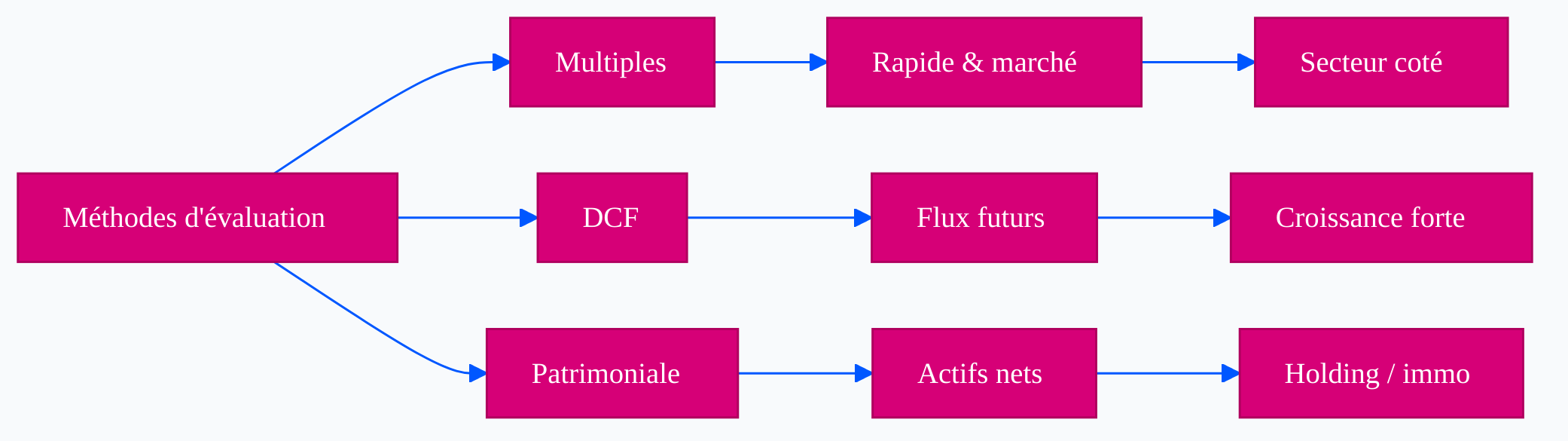
The three main methods: which one to choose?
Switzerland imposes no single valuation method. The official KMU portal recognizes five approaches, and Swiss fiduciary experts systematically combine three of them for SMEs, according to the TREX 2021 article by Meier-Mazzucato. Each method captures a different angle of value: the market, the future, the floor. Crossing them is what separates a defensible valuation from a number pulled out of a hat.
The multiples method (EBITDA or EBIT)
This is the dominant approach in French-speaking Switzerland for SMEs and commercial businesses. The principle: multiply normalized EBITDA by a coefficient observed in comparable transactions. The coefficient reflects sector, size, perceived risk, and local position.
The multiples below correspond to ranges observed on the European market in 2024 to 2025, compiled by Xval and Financyal, applicable to French-speaking Switzerland with a slight discount for very small structures (less than CHF 500,000 in turnover).
| Sector | Typical EBITDA multiple | Example: EBITDA CHF 100,000 |
|---|---|---|
| Restaurant / cafe (independent) | 3x to 4x | CHF 300,000 to 400,000 |
| Hospitality (small structure) | 3.5x to 4.5x | CHF 350,000 to 450,000 |
| Retail (small) | 2.5x to 4x | CHF 250,000 to 400,000 |
| Distribution / structured trade | 4x to 5.3x | CHF 400,000 to 530,000 |
| B2B services, recurring clients | 4x to 7x | CHF 400,000 to 700,000 |
| Hair salon / beauty | 1.5x to 3x | CHF 150,000 to 300,000 |
| Crafts / food trades | 2x to 4x | CHF 200,000 to 400,000 |
These ranges must be checked against real transactions observed locally. A well-located restaurant in Geneva does not command the same valuation as the same concept in Bulle. The upper end of the range has to be earned: stable profitability over three years, a long transferable lease, a diversified customer base, an autonomous team. The lower end corresponds to risky files: dependence on the owner, a short lease, volatile results.
The DCF method (Discounted Cash Flows)
Discounted cash flows project future revenues over five to ten years, then bring them back to present value using a discount rate. This rate reflects risk: the more fragile the business or the more dependent on the owner, the higher the rate, the lower the present value. For unlisted SMEs in French-speaking Switzerland, experts commonly use rates of 8 to 14% depending on the profile, according to Raiffeisen.
DCF is powerful when projections are credible: a grocery store stable for eight years confirms its multiple valuation. For a business with documented growth, DCF can reveal a higher value. For a seasonal restaurant or a business dependent on a key person, DCF produces unstable results: handle with care or set aside.
The asset-based method
This calculates the net asset value: what the business actually owns (machines, furniture, stocks, fit-out) minus what it owes (debts, suppliers). It suits capital-intensive sectors: hospitality with integrated real estate, equipped bakeries, light industry.
For a services business or a restaurant where most of the value lies in the customer base, the brand, and the know-how, the asset-based method alone produces a figure well below reality. It serves as a floor, rarely as the central value.
The practitioners' method: the Swiss hybrid standard
A Swiss specificity rarely taught in international textbooks: the practitioners' method combines intrinsic value (asset-based) and earnings value into a weighted average. In Switzerland, the weighting is one times intrinsic value and two times earnings value, according to the TREX 2021 article. This method is often used as a reference point in divorce or succession disputes and is still applied by cantonal tax courts.
Simplified formula: Value = (1 x intrinsic value + 2 x earnings value) / 3. This approach produces an intermediate result between pure asset-based value and pure multiples. It is useful to anchor a negotiation with a buyer who contests an optimistic multiple.
When to set a method aside
A good valuation does not mean blindly averaging the three methods. A method that is relevant for one profile can become misleading for another:
- For a seasonal restaurant dependent on the owner: DCF produces unstable projections. Rely on multiples and asset-based value, then weight them with the practitioners' method.
- For a services business with no heavy assets: the asset-based method alone massively undervalues. It serves as a floor, not as a central value.
- For a business with documented strong growth: historical multiples understate value. DCF becomes the reference tool.
- For a holding or real estate company: the asset-based method dominates, other methods become secondary.
Jean's example, tested across the three methods
Jean runs his restaurant in Nyon with a normalized EBITDA of CHF 72,000. Here is what each method produces:
- Multiples (3x to 4x for an independent restaurant): CHF 216,000 to 288,000
- DCF (7-year projection, 11% discount rate given seasonality and owner presence): CHF 240,000 to 310,000
- Asset-based (furniture, kitchen equipment, fit-out, stocks): CHF 55,000 to 75,000, a clear floor
- Practitioners' method (average of 1 x 65,000 + 2 x 275,000) / 3: about CHF 205,000
The three earnings-based methods (multiples, DCF, practitioners') converge in a range of CHF 205,000 to 310,000. The asset-based floor confirms that any offer below CHF 75,000 would be indefensible. Defensible valuation range: CHF 240,000 to 290,000, with a listing price of CHF 280,000 that leaves reasonable room for negotiation without exceeding bank financing capacity (see the Financing section).
The concrete steps to value your business goodwill
Five steps, in order, each one conditioning the next. Count roughly forty to sixty hours of work for a serious in-house valuation, or two to three weeks of lead time with a specialized fiduciary.
Step 1: Gather your financial documents
Bring together the last three to five complete financial years: balance sheet, income statement, notes, tax returns, and VAT statements. Add the business plan or forecast budget if you have one, the detailed equipment inventory with purchase years and residual values, the key contracts in force (lease, key suppliers, recurring clients), cantonal permits and authorizations, and any recent tax or social audits.
Five years of accounts are worth more than three: they help identify cycles and real trends, and give the buyer a defensible view of risk. The weighting in the multiple calculation will be more favorable on a long, stable series.
Step 2: Normalize the accounts, where 20 to 40% of the value is at stake
The annual accounts of a Swiss SME reflect a tax reality, not an economic reality. Normalization adjusts reported EBITDA to reflect the real profitability a buyer can actually operate. According to specialized French-Swiss fiduciaries, these adjustments move reported EBITDA by 20 to 40% in most SME files.
Here are the adjustments to apply systematically, beyond the three classic ones:
- Owner salary normalized to market. If you pay yourself 80,000 while a restaurant manager of this size costs between 110,000 and 140,000 on the market (executive with lump-sum overtime above the CCNT threshold of CHF 6,750 monthly, according to GastroSuisse), the difference reduces normalized EBITDA by the same amount.
- Owner social contributions. A sole proprietorship contributes to AVS as self-employed at a lower rate than an employee. For a buyer who takes over via a Sàrl, the social charge will increase by about 6 to 7 points: this must be built into the normalization.
- Intra-group rent. If the premises belong to a real estate company you own, bring the rent back to market. An artificially low rent inflates EBITDA; a rent inflated via a personal real estate company unduly reduces it.
- Personal vehicles and insurance charged to the company. Family cars, life insurance, personal liability, supplementary health insurance: remove these charges if the buyer will not keep these benefits.
- Informal helping spouse. If your spouse works in the business without being paid or only symbolically paid, include a market-equivalent salary in the normalization: their presence disappears after the sale.
- Residual COVID provisions. Short-time work debts repaid or COVID loss provisions from 2021 to 2022 still distort the 2023 to 2024 accounts of some SMEs. Isolate them as exceptional items.
- Non-recurring revenue. A wedding banquet worth CHF 50,000 in 2023, a one-off contract with a major client since lost, an exceptional delivery: anything that will not repeat must be neutralized.
- Exceptional fiduciary and legal fees. Divorce-related work, a one-off tax audit, litigation defense: isolate them.
- Unprovisioned paid leave, overtime, and holidays. Across 3 to 4 employees, under-provisioning can hide CHF 10,000 to 20,000 of real annual charges.
- Leasing and depreciation on obsolete unused equipment. A walk-in cooler leased eight years ago whose monthly cost still runs should be treated as a charge to be removed, not as an ongoing operating charge.
The normalization methodology is documented by Xval and evaluation-entreprise.com. Recalculate normalized EBITDA over 3 years, then produce a weighted average (coefficient 3 for the most recent year, 2 for N-1, 1 for N-2).
Practical tip: Many sellers undervalue their business because they minimized their compensation to optimize social charges. A savvy buyer will systematically recalculate this line. Anticipate it yourself before quoting a number, and present a transparent normalization table at the first meeting: you take the lead in the negotiation.
Step 3: Value intangible assets and the lease
Your goodwill is often worth more than its physical assets. Intangible assets typically represent 50 to 80% of the total value of a services or restaurant business. Review them one by one:
- The commercial lease. A major item, governed by article 263 of the Code of Obligations. Transfer to a buyer requires the written consent of the landlord, who has about four weeks to decide and can only refuse on good grounds (insolvency, professional incapacity, change of use). The former tenant remains jointly liable for rent for up to two years after the transfer, according to Codex Avocats Lausanne.
- A long lease (more than seven years) with a transferability clause and a rent below market is a valuable asset that can justify a premium on the multiple. Conversely, a lease that can be terminated within less than three years triggers a significant discount: no visibility for the buyer, no easy bank financing.
- The customer base. An active customer file with a high repeat rate is not valued like walk-in traffic. A rule of thumb: if the top ten clients account for more than 30% of revenue, concentration increases risk and reduces the multiple. Below 30% is a robustness signal.
- The brand and reputation. Volume and quality of Google and TripAdvisor reviews, local awareness, framework contracts with partners (suppliers, insurers, restaurant groups). No magic valuation formula, but a solid narrative in negotiation.
- Cantonal permits and authorizations. Restaurant license, operating authorization, alcohol permit, OFSP registration: the transferability of these authorizations conditions the handover. A non-transferable license forces the buyer to file a new application, which lengthens the timeline and introduces risk.
- Supplier relationships. Negotiated payment terms, annual volumes, exclusivities, seniority: all elements to document in the sale file.
- Stocks. Valued at actual cost, not at catalog sales price. Systematically deduct obsolete or unsellable stocks.
Step 4: Compare with real transactions (benchmarking)
Theoretical multiples from a sector table are not enough. They must be checked against real transactions observed in your sector and region over the past 12 to 24 months. Useful sources in French-speaking Switzerland include:
- TREX publications (The Fiduciary Expert): methodological reference articles for Swiss practitioners, available in the archives.
- KMU.admin.ch portal and the wevalue.ch tool: official guide and structured simulator.
- Sector multiples from Xval and Financyal: European 2024 to 2025 data, to be adjusted with a discount for very small Swiss-Romand structures.
- Multiples aggregators Nimbo: monthly publication based on more than one thousand SMEs.
- French-Swiss fiduciaries specialized in transfers. Members of Treuhand Suisse or ExpertSuisse: they observe local transactions and can provide recent comparables under NDA.
A 4x EBITDA multiple for a Geneva retail business may look high on paper, yet remain consistent with recent sector transactions. Local verification is what separates a defensible valuation from the mechanical application of ratios.
Step 5: Cross-check methods and resolve divergences
Compute the value with multiples, with DCF, with the practitioners' method, and compare it to the asset-based floor. Convergence within a narrow range (gap below 25% between low and high) signals a defensible valuation. A wider divergence deserves investigation.
Typical divergence example: multiples 280,000, DCF 380,000, asset-based 90,000, practitioners' method 210,000. The gap between multiples and DCF (100,000) likely signals an overly optimistic growth assumption in the DCF, or conversely historical multiples that understate real potential. The asset-based floor (90,000) confirms that a very low offer is indefensible.
Reconciliation: weight with the practitioners' method, document the DCF assumptions (growth, discount rate), and adjust toward the lower bound of the multiples-DCF pair if the business is seasonal or owner-dependent. The final negotiation range then settles around 240,000 to 300,000, rather than a single central value to defend at all costs.

What drives value up or down
Two businesses in the same sector, with the same revenue, can sell at very different prices. The following factors move the needle, sometimes by up to 30% on either side of the central value. The exact impact percentages depend on the individual file: this table gives the direction and order of magnitude observed in French-Swiss files, as documented in the TREX 2021 article by Meier-Mazzucato.
| Factor | Impact | Threshold or rule |
|---|---|---|
| Stable or growing profitability over 3 years | Premium on the multiple | Documented trend, not a single year |
| EBITDA declining over 2 years | Significant discount | Drop > 10% with no explanation |
| Diversified customer base | Reference multiple preserved | Top 10 clients < 30% of revenue |
| Dependence on a key client | Significant discount | Top 1 client > 40% of revenue |
| Long, transferable lease, below-market rent | Moderate premium | Remaining term > 7 years |
| Short or non-transferable lease | Significant discount | Remaining term < 3 years |
| Autonomous team in place | Moderate premium | Business runs without the owner's daily presence |
| Heavy dependence on the owner | Heavy discount | Personal contact book, non-transferable skills |
| Pending litigation not provisioned | Discount = max risk | Social, tax, or litigation debt |
| Recent equipment at net value | Moderate premium | < 3 years, aligned with the inventory |
| Social or VAT liabilities overdue | Heavy discount | To be fully provisioned before negotiation |
Two lines in the table deserve special attention. Owner dependence is often the biggest discount item in a French-Swiss file: a business whose owner is on the floor or in the kitchen six days a week does not trade at the same multiple as a managed business. The second critical point is the lease, because a bank will struggle to finance a takeover where rental visibility is under five years.
The eighteen months before the sale are when the seller can still act on these two levers: build an intermediate management layer, negotiate a lease rider, formalize critical processes, document the customer relationship in a CRM. Every action completed before the listing is published becomes a quantified argument with the buyer.
Financing the takeover: what French-Swiss banks accept
The best valuation in the world is worth nothing if no bank accepts to finance your sale price. The buyer will pay what their banker agrees to lend, plus their own equity. Knowing the rules on the bank side helps set a realistic price from the listing onwards, rather than negotiating it down six months later.
The expected equity contribution: 25 to 40%
For an SME or goodwill takeover, UBS and Raiffeisen generally require personal equity of 25 to 40% of the total price, adjusted for sector and buyer profile. Restaurants and hospitality sit at the upper end, because seasonality and owner dependence increase perceived risk. A B2B services business with recurring clients drops toward the lower bound.
The acquisition loan is typically repaid over six to seven years through the cash generated by operations. Concretely: your normalized EBITDA must cover the debt annuity with a safety margin of 20 to 50%, otherwise the bank refuses.
Cautionnement Romand: the often-forgotten lever
The Cautionnement Romand guarantees bank loans up to CHF 1,000,000 for French-Swiss SMEs, including in takeover projects. The Confederation covers 65% of the loss risk, which allows the bank to accept a file it would have refused without additional guarantee.
Access conditions: demonstrated professional capacity for the activity taken over, a viable business on the basis of the accounts, up-to-date bookkeeping. Fees: 1% of the guaranteed loan as review fees (minimum CHF 500, maximum CHF 2,700) and 1.25% per year as a risk premium on the guaranteed amount, according to the State of Vaud.
For a buyer with limited personal collateral, this lever can be the difference between a refused and an accepted file. The seller who mentions Cautionnement Romand eligibility from the moment the listing goes live mechanically broadens the pool of solvent buyers.
Worked example: Jean's restaurant in Nyon
Let us take Jean again, with a normalized EBITDA of CHF 72,000 after adjusting the owner salary. Multiples valuation range 3x to 4x: CHF 216,000 to 288,000. The seller sets CHF 280,000 as the listing price.
On the buyer side, here is the typical file:
- Personal equity 30% of the price: CHF 84,000
- Bank loan: CHF 196,000 over 7 years at an indicative rate of 3.5%
- Cautionnement Romand covering 50% of the loan: CHF 98,000 guaranteed, enabling the bank to accept the file
- Annuity: about CHF 32,000 per year, close to CHF 2,670 per month
To validate feasibility, the bank looks at a simple ratio: debt service must stay at a maximum of 60 to 70% of normalized EBITDA. Here, CHF 32,000 of annuity on CHF 72,000 of EBITDA = 44%. The file passes.
If Jean listed at CHF 380,000 instead of 280,000, the loan would rise to CHF 266,000, the annuity to nearly CHF 43,000, and the ratio to 60% of EBITDA: borderline for the bank. This is precisely where many transactions fail, despite a seemingly defensible valuation.
Key takeaway: listing a price that no French-Swiss bank can finance effectively limits your business to the rare cash buyers, who will negotiate a discount anyway. Valuing only through multiples, without cross-checking against financing capacity, means promising a price the market will not confirm.
Sale taxation: the asset deal vs share deal trade-off
Two sellers with exactly the same business and the same sale price can walk away with a CHF 100,000 gap in net proceeds after tax. The difference does not come from negotiation, but from the legal structure chosen five years before the sale. It is probably the highest-impact decision on your retirement wealth, and also the one that generic articles avoid discussing.
Asset deal: the sale of goodwill by a self-employed operator
If you operate as a sole proprietorship or a partnership, you sell the goodwill assets one by one: equipment, stocks, goodwill, lease taken over. The resulting capital gain is taxed as ordinary professional income at your marginal federal, cantonal, and communal rate, according to VZ VermögensZentrum and RSM Switzerland. For a seller based in Vaud whose sale gain pushes annual taxable income above CHF 150,000, the combined marginal rate commonly reaches 35 to 40%.
Order of magnitude: on a CHF 250,000 capital gain, the tax bill can represent CHF 80,000 to 100,000. AVS contributions on self-employed income are added to this amount depending on your situation.
Share deal: the sale of shares of a privately held Sàrl or SA
If your business is operated through a Sàrl or an SA, and the shares are held as private wealth, a sale to an individual buyer triggers a tax-exempt private capital gain. Zero income tax, zero taxable capital gain, subject to the three pitfalls described below.
This is the mechanism whereby the same economic transaction can cost zero or CHF 100,000 depending on the legal form of the company.
Pitfall 1: indirect partial liquidation
The exemption falls away if the five cumulative conditions of indirect partial liquidation (LPI) are met, according to BDO:
- You sell a participation held privately
- The buyer is a legal entity, or a self-employed person who records it as a business asset
- The participation represents at least 20% of the capital
- Reserves not required for operations are distributed within the five years following the sale
- You knew that these distributions would be used to finance the purchase price
Concretely, if the buyer finances part of the price by draining the reserves of the acquired company within five years, you must prove you had no knowledge of it. Otherwise, the administration reclassifies the capital gain as taxable income.
Pitfall 2: transposition
If you sell your shares to your own holding company (owned at least 50%) at a price higher than the nominal value, the difference is taxed as income, according to Weka. This classic wealth-optimization setup cannot be improvised.
Pitfall 3: the five-year delay after legal transformation
If you operate as a sole proprietorship and convert your structure into a Sàrl or SA in order to benefit from the tax-exempt private capital gain, the tax administration waits five years before recognizing this new form, according to Le Temps and the CVCI transfer vademecum. A conversion six months before the sale will be reclassified as a disguised asset deal, with ordinary taxation.
The practical lesson: if you plan to sell within three years and operate as a sole proprietorship, switching to a company is probably no longer a useful option. On the other hand, five or six years before the sale, this is a conversation to have with a tax specialist.
LPP buy-ins: smoothing the tax hit before the sale
For a seller in an asset deal, voluntary buy-ins into the 2nd pillar over the three to five years preceding the sale reduce the taxable income of the sale year. A buy-in of CHF 60,000 deductible from income can represent CHF 20,000 of tax saved depending on your marginal rate, according to the State of Geneva and GeTax.
Crucial rule: a buy-in cannot be withdrawn as capital before a three-year period. An earlier withdrawal triggers a tax reassessment with retroactive removal of the deduction, according to the PKS-CPS notice. Planning buy-ins three to five years before the sale, then leaving the capital as a pension or withdrawing it at statutory retirement age, is the clean sequence.
VAT: conditional neutrality
The transfer of a set of assets forming an economic unit benefits from the notification procedure provided by article 38 of the VAT Act, according to the Actu-TVA from Fiduciaire Suisse. Concretely: the transaction is declared to the Federal Tax Administration via form No. 764, no VAT is charged on the price, and the buyer takes over the seller's VAT regime. The procedure is mandatory above a calculated VAT threshold of CHF 10,000.
Forgetting this notification exposes the transaction to a VAT reassessment of 8.1% on the sale price, sometimes several years later. The formality is free and is settled in half an hour with the fiduciary. There is no reason to skip it.
Jean's case, translated into figures
Jean has been running his restaurant as a sole proprietorship for 22 years. If nothing changes, the sale of goodwill at CHF 280,000 with a book value of CHF 30,000 produces a taxable capital gain of CHF 250,000, subject to income tax plus self-employed AVS. Estimated tax bill: CHF 75,000 to 95,000 depending on family situation and ordinary income level.
Had Jean converted his sole proprietorship into a Sàrl in 2021 (five years before the sale planned for 2026), the sale of shares to an individual buyer would be exempt from capital gains tax, subject to the three pitfalls above. Net gain: the same amount of CHF 75,000 to 95,000. A decision made five years earlier is worth more than the best price negotiation.
At this stage, the right reflex is a call to a tax specialist who models both scenarios with your actual figures, not a blog article. But knowing these rules lets you arrive at that meeting with the right questions.
When to call in an expert, and whom
Three expert profiles can intervene in a French-Swiss valuation. Their skills, their biases, and their fees differ. Choosing the right profile for your file means avoiding paying dearly for a deliverable that does not hold up in negotiation.
| Profile | Independence | Indicative fee | Relevance |
|---|---|---|---|
| General fiduciary | Medium (often your usual fiduciary) | CHF 80 to 250 per hour, or fixed fee CHF 500 to 1,500 | Businesses below CHF 500,000 in value, simple files |
| Certified fiduciary expert (TREX) or ExpertSuisse-certified chartered accountant | Strong | CHF 150 to 300 per hour, typical mandate CHF 3,000 to 8,000 | Complex files, above CHF 500,000 in value, holdings, integrated real estate |
| Business broker | Low (commission on the sale) | Free valuation, commission 5 to 8% of the sale price | When you also look for the buyer through their network, beware of the optimism bias on value |
The fees are consistent with the ranges published by Finwise and the members of Treuhand Suisse. For a typical CHF 300,000 file, count about 20 to 40 hours of work for a full report.
Classic pitfall: value for convenience vs. market value
A good expert calculates two distinct values depending on your purpose. The value for convenience serves family transfers and tax calculations (donations, inheritance tax): it is generally cautious, oriented toward the asset-based floor. The market value serves to set a sale price to a third party: it reflects the maximum a well-informed buyer would accept to pay under market conditions.
These two values can diverge by 30 to 50%. A seller who confuses them, or a fiduciary who does not flag the distinction, enters negotiation with the wrong number. Ask the question explicitly when signing the engagement letter.
The engagement letter: the five items to require
- Objective: market value in view of a third-party sale, value for convenience for a family transfer, or both.
- Scope: goodwill only, company shares, real estate included or not.
- Methods used: multiples, DCF, asset-based, practitioners' method. Require at least three methods cross-checked.
- Deliverable: written report explaining the assumptions, a reasoned value range, not a single figure.
- Confidentiality and independence: mutual NDA, no future commission on any eventual sale.
For businesses whose estimated value exceeds CHF 300,000, a written report from a certified expert protects the negotiation: it serves as an objective reference that neither seller nor buyer can wave away.
Key takeaway: A free valuation or one completed in 10 minutes provides an order of magnitude, not a negotiable value. For a serious transfer, accuracy is worth the cost of an expert.
Checklist: the 12 to 18 months before publishing your listing
A well-conducted valuation produces a value range. What you do between that valuation and publishing the listing determines whether you sell at the low or the high end. Here is the optimal sequence, designed for a seller aiming at a serious transfer within 12 to 18 months.
- Months -18 to -12: Normalize your compensation. If you underpaid yourself to optimize social charges, raise your salary to market level for at least three financial years. This makes the sale-time normalization easier to defend and stabilizes reported EBITDA.
- Months -18 to -6: Reduce owner dependence. Train a second-in-command, delegate strategic purchasing, formalize procedures, document the customer file in a CRM. Every action reduces the dependence discount.
- Months -12 to -6: Secure the lease. Negotiate an extension rider or an explicit transferability clause with the landlord, relying on article 263 CO.
- Months -12 to -6: Smooth results. Avoid exceptional transactions that artificially inflate or reduce the EBITDA of the year preceding the sale.
- Months -36 to -6: Activate LPP buy-ins. Plan voluntary 2nd pillar buy-ins three to five years before the sale, respecting the three-year blocking period to preserve the tax deduction.
- Months -12 to -6: Audit pending disputes and book provisions. Any unprovisioned social, tax, or commercial litigation will surface during due diligence.
- Month -6: Commission the professional valuation. With normalized accounts over 3 years, a secured lease, and reduced dependence, you are positioned to obtain the defensible upper range.
- Month -3: Prepare the engagement letter and the data room. Financial documents, contracts, inventory, authorizations, legal opinions, ready to present to a serious buyer.
- Month 0: Publish the listing at a price consistent with bank financing capacity (see Financing section), not aligned only with the theoretical multiple.
A defensible value range is your negotiation tool against a skeptical buyer, your argument with a bank financing the takeover, and your benchmark to calibrate your expectations. Accuracy is worth the cost of an expert, especially when it earns you CHF 50,000 to 100,000 on the final price.
If you plan to sell your business in French-speaking Switzerland, a prior valuation shortens the time between listing and first serious contact, and raises the probability of a transaction at your listing price rather than at a negotiated lower bound.
Frequently asked questions
Which valuation method is most commonly used for a business in Switzerland?
In French-speaking Switzerland, the earnings multiples method (EBITDA or EBIT) is the most widely used for SMEs and shops. It consists of multiplying the normalised operating result by a sector coefficient observed on the local market. Experts generally combine it with a DCF approach and an asset-based floor to obtain a complete valuation range.
Is there a mandatory valuation method in Switzerland?
No. Switzerland imposes no single method for valuing a business or an SME. A professional recommendation has existed since April 2008 (published by TREX), but it remains indicative. Experts are free to combine approaches depending on the profile of the company being valued.
How do you calculate the normalised EBITDA of a business?
Normalised EBITDA is obtained by starting from the gross operating result, then neutralising non-recurring items (asset sales, exceptional expenses) and replacing the owner's actual compensation with a market-rate salary for the position. A weighted average is then computed over 3 years, giving more weight to the most recent financial year.
How much does a professional business valuation cost in Switzerland?
For a business with annual turnover below CHF 1 million, a professional valuation carried out by a specialised expert can start from CHF 750 (according to rates quoted by providers such as Xval). The cost rises with structural complexity. For a six-figure transfer, this investment is generally justified by the precision of the result.
Which documents should you gather before valuing your business?
The essentials are the last three full annual accounts (balance sheet and income statement), the corresponding tax returns, recent VAT statements, the commercial lease with all amendments, the list of assets (inventory, equipment, fit-out), and ideally a business plan or forecast budget. These items form the basis of any serious valuation.
How much equity do you need to finance the acquisition of a business in Switzerland?
Romandie banks (UBS, Raiffeisen, BCV) typically require an equity contribution of 25 to 40% of the total acquisition price, adjusted for sector and profile. Hospitality and hotels sit at the upper end of the range. The loan is usually repaid over 6 to 7 years, with debt service that must not exceed 60 to 70% of normalised EBITDA. Cautionnement Romand (CRC-PME) can guarantee up to CHF 1,000,000 of credit to strengthen a file.
What is the tax difference between selling a business and selling the shares of a Sàrl in Switzerland?
The sale of the business by a sole trader (asset deal) generates a capital gain taxed as ordinary professional income, at a combined marginal rate that commonly reaches 35 to 40% for a Romandie seller. The sale of the shares of a privately held Sàrl or SA (share deal) to a natural person benefits from the tax-exempt private capital gain, subject to the three classic pitfalls (indirect partial liquidation, transposition, 5-year holding period after a legal restructuring). The gap can reach CHF 100,000 for a sale at CHF 300,000.
Related articles

SME Due Diligence: The Complete Checklist Before Signing
The complete checklist for conducting due diligence on a Swiss SME: financial, legal, HR, operational. Step-by-step method for buyers and sellers.

Financing an SME Acquisition in Switzerland: 7 Proven Solutions
Bank loan, seller financing, public sureties, leasing, equity: 7 concrete solutions to finance your SME acquisition in Switzerland.
Businesses for Sale in French-Speaking Switzerland: 2026 Market Overview
2026 market overview of businesses for sale in French-speaking Switzerland: real prices, leading sectors, key legal points, and cantonal aid for buyers.