You've found the SME you want to acquire. The price works, the seller is motivated, your banker has given the green light. One step remains that many buyers underestimate: due diligence. This is where beautiful promises are verified... or fall apart.
This guide gives you the concrete, step-by-step method to conduct a thorough due diligence on a Swiss SME, whether you're a buyer or a seller.
What is due diligence and why is it non-negotiable?
Due diligence is an in-depth examination of the business before its acquisition. The SECO (Swiss State Secretariat for Economic Affairs) defines it as a detailed analysis preceding valuation and signature, intended to assess earning potential and legal and tax aspects of the target (according to the SECO SME Portal).
Its purpose is clear: to gather maximum information on opportunities and risks to facilitate three concrete decisions.
- Validate, adjust, or reject the asking price
- Decide to buy or walk away
- Define warranties and clauses in the purchase agreement
Due diligence applies to all SME acquisitions, of course, but also to investor entry, mergers, or management buy-outs. SMEs represent 99.7% of Swiss businesses and account for two thirds of the country's jobs (according to the STATENT structural business statistics, Swiss Federal Statistical Office). Every year, thousands of business transfers depend on the quality of this examination.
Key takeaway: Due diligence is not a formality. This is when you discover what the accounts don't spontaneously reveal. Complete it properly, and you sign with full knowledge. Skip it, and you're buying an unknown risk.
When to launch due diligence and how to plan it
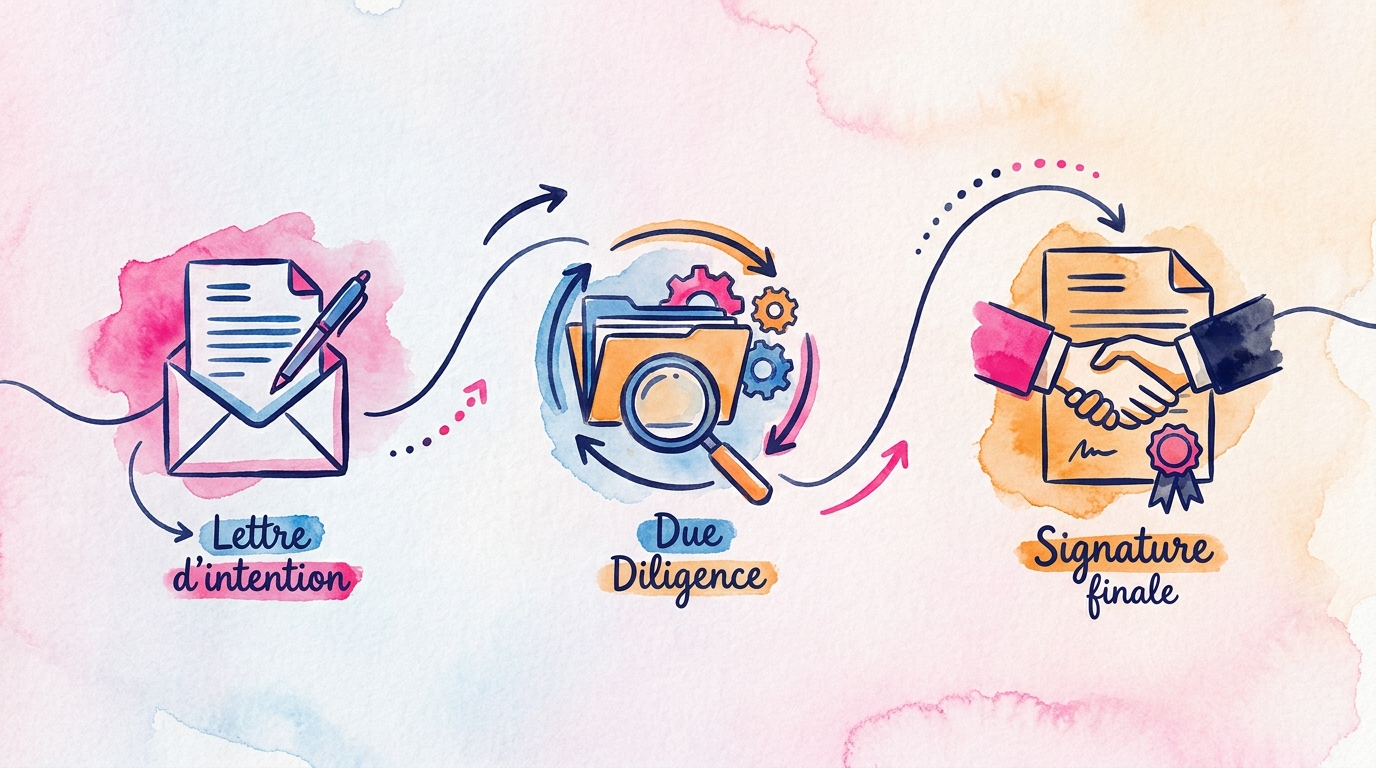
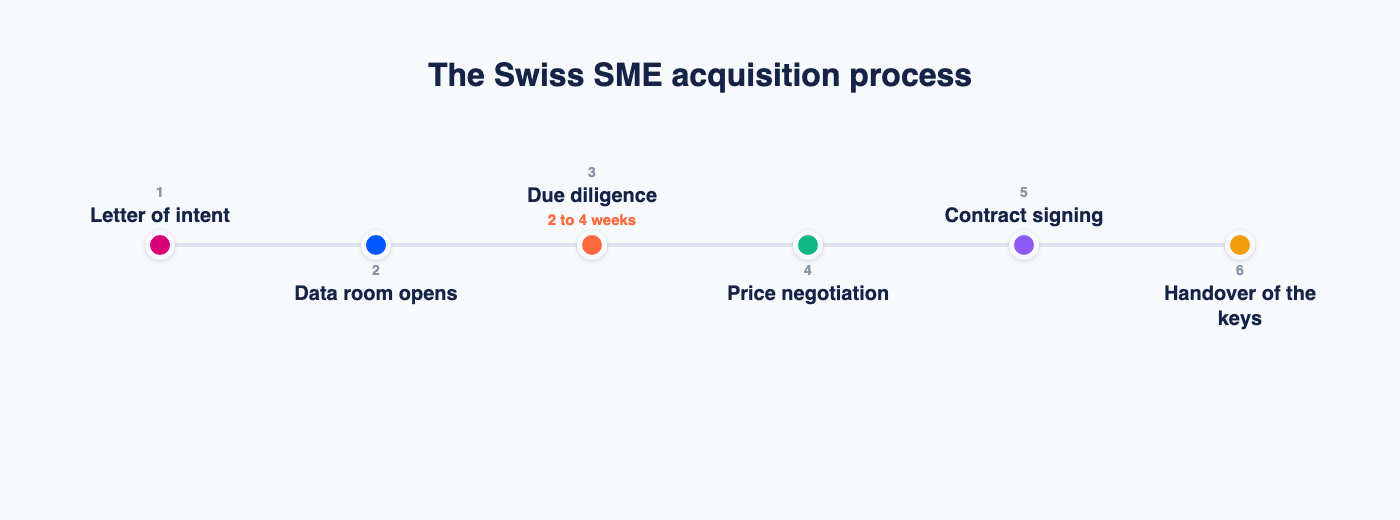
Due diligence is triggered after the letter of intent is signed, before the final contract. This is the window where the seller opens their books and the buyer has the right to ask all questions.
For a well-documented SME, plan for two to four weeks covering document collection, analysis and Q&A sessions. If the accounting is disorganized or the structure includes several entities, the timeframe can double (according to ARK Fiduciaire, key checks before buying a Swiss SME).
Structure your plan in four blocks
| Block | What you define | Concrete example |
|---|---|---|
| Scope | Areas to audit (financial, legal, HR, operational) | Exclusion of a dormant subsidiary not being acquired |
| Schedule | Document delivery dates, Q&A sessions | D+15: delivery of accounts; D+30: answers to questions |
| Responsibilities | Who leads what (buyer, accountant, lawyer) | Accountant handles financials, lawyer handles legal |
| Budget | Advisor fees, data room, travel | Plan for CHF 3'000 to 15'000 depending on SME size |
The three main types of due diligence to cover
Serious due diligence covers three dimensions. Overlooking any of them means buying with blinders on.
Financial due diligence
It analyzes historical performance over 3 to 5 years, quality of results, net debt, working capital requirements, and planned investments. This is often where the costliest surprises emerge.
Legal and tax due diligence
It reviews bylaws, key contracts, regulatory compliance, pending litigation, and tax situation (direct taxes, VAT, social insurance). In Switzerland, cantonal specificities add a layer of complexity you cannot ignore.
Operational, HR and commercial due diligence
It examines organization, processes, owner-manager dependency, customer portfolio structure, and supplier relationships. An SME where 60% of revenue comes from two customers represents a real structural risk, even if the accounts look clean.
Financial checklist: what you absolutely must verify
Which figures must you demand before signing? Here are the documents and points to analyze systematically. This list draws from recommended practices for SME succession in Switzerland.
Documents to obtain
- Annual accounts for the last 3 fiscal years (balance sheet, profit and loss, notes)
- Budget for Year N+1 and possibly forecasts for N+2
- Cash position as of the due diligence date
- Net debt schedule (bank loans, shareholder current accounts, leasing)
Analyze the quality of results
Don't stop at the stated profit. Ask for adjusted EBITDA: the operating profit corrected for everything that won't recur under your ownership. The most frequent adjustments on a Swiss SME:
- Owner-manager salary below or above market rate for the role
- Below-market rent when the premises belong to the seller or their family
- Personal expenses charged to the company (vehicle, travel, private insurance)
- Non-recurring items: asset sale, exceptional subsidy, settled litigation
- Deferred investments you will have to finance after the takeover
Concrete example: a cleaning company in Renens, 11 employees, shows a profit of CHF 240'000. Due diligence reveals an owner salary CHF 70'000 below market and CHF 60'000 in deferred vehicle maintenance. Adjusted EBITDA drops to CHF 110'000. A price negotiated on the stated profit would have been overpaid by a factor of two. The full valuation method is detailed in our guide on valuing a business in Switzerland.
Also watch the working capital requirement. A company that collects from customers at 60 days but pays its suppliers at 30 permanently carries one month of revenue in its cash position. If the working capital observed at the time of the transaction durably exceeds the historical level, the difference belongs in the price negotiation or in the contract.
Specific points of concern
- Customer concentration: vigilance starts when one customer exceeds 20% of revenue; above 30%, it's a warning sign that weighs on the price
- Off-balance-sheet commitments: guarantees given, endorsements, long-term rental contracts
- Standard working capital requirements vs. current working capital
- Replacement investments needed in the short term (machinery, vehicles, IT systems)
Legal, tax and compliance checklist
This is often the most feared part, yet the one that best protects the buyer. An undetected legal issue can jeopardize the entire transaction after signature.
Structure and governance
- Current bylaws, recent extract from the commercial register
- Minutes from shareholder meetings over the last 3 years
- Current signatory authority and delegations
- Actual shareholding and ownership structure
Contracts and risks
- Strategic customer and supplier contracts (change of control termination clauses)
- Business lease: remaining term, transfer conditions, rent
- Licenses, trademarks, patents, intellectual property
- Pending or potential litigation, attorney correspondence
The lease deserves particular attention. Its transfer requires the landlord's written consent, which can only be refused for just cause, and the outgoing tenant remains jointly liable for the rent with the buyer for up to two years (art. 263 of the Swiss Code of Obligations). Get the landlord's consent before signing, not after.
On the personnel side, the rule surprises many buyers: in a business transfer, all employment contracts pass automatically to the acquirer, with the rights and obligations attached to them. The former and the new employer are jointly liable for claims that fell due before the transfer: untaken vacation, overtime, bonuses owed (art. 333 of the Swiss Code of Obligations). Demand the detail of the corresponding provisions in the accounts.
Swiss tax and compliance
In Switzerland, several points are specific and often underestimated by inexperienced or foreign buyers.
- Tax returns for the last 3 fiscal years and tax assessments
- VAT situation: declarations, any past audits
- Social insurance compliance and contributions (compensation fund statements)
- Cantonal permits and sector-specific licenses (hospitality, healthcare, finance...)
Warning: An unprovisioned social insurance or VAT adjustment can amount to tens of thousands of francs. Systematically verify payment receipts for social contributions over the past five years.
Every risk detected here translates into the contract. Swiss practice provides for contractual warranties of 12 to 24 months on the seller's representations, within the legal two-year limit for defects in the object sold (art. 210 of the Swiss Code of Obligations). Your lawyer will calibrate the duration and caps based on the risks identified during due diligence.
Operational, HR and commercial checklist

Business model and operations
How does the company actually make money? Ask for a clear description of the value chain, critical processes, and IT systems in use.
An SME whose processes rely entirely on undocumented Excel files represents a real operational risk for the buyer.
Human resources
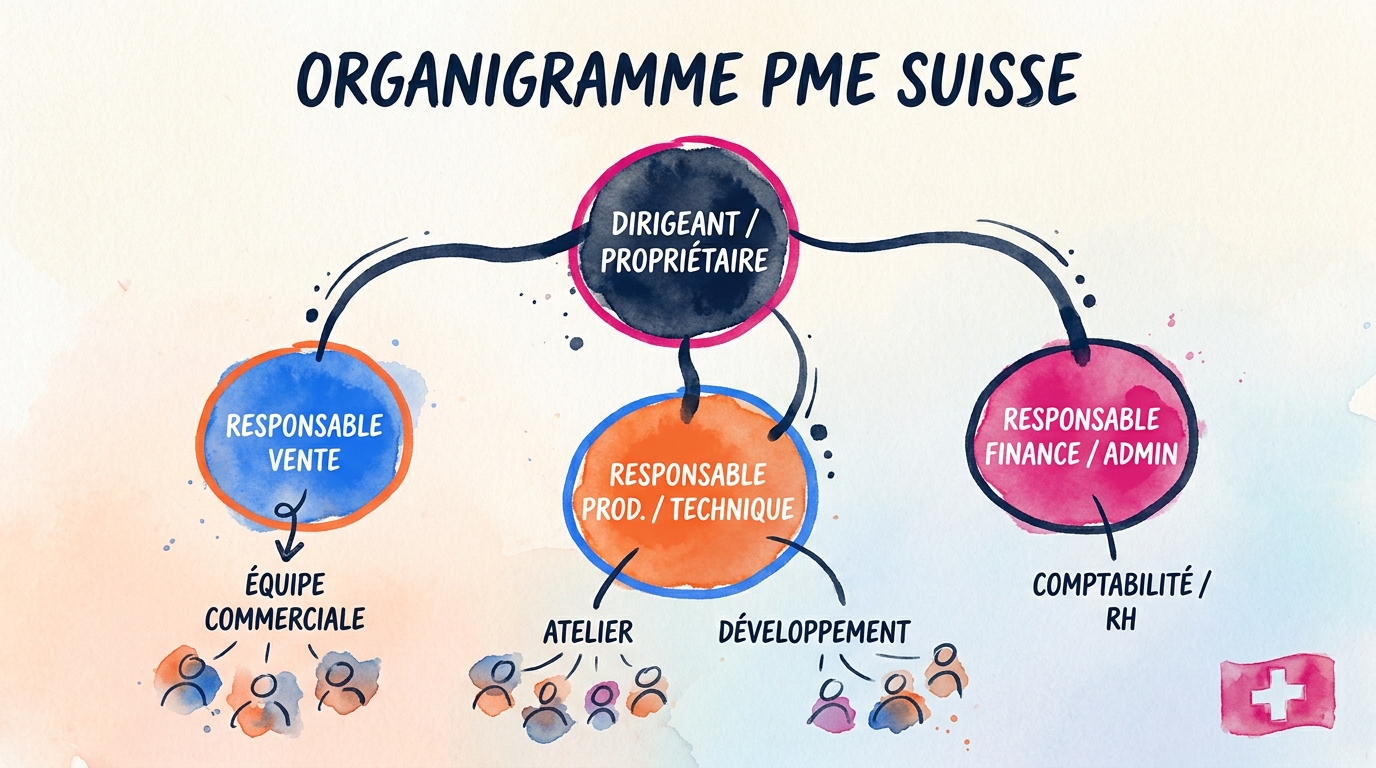
- Complete personnel register and current organization chart
- Employment contracts for management and key staff (non-compete clauses, notice periods)
- Seniority and provisions for vacation and overtime
- Applicable collective labour agreement and compliance with minimum wages
- Honest assessment of owner-manager dependency
The collective agreement point is typically Swiss and often overlooked. The national collective labour agreement (CCNT) imposes minimum wages in hospitality and catering, and the collective agreements of the construction finishing trades in French-speaking Switzerland do the same for crafts. Staff paid below the agreed minimums constitutes a catch-up liability that will fall on you after the takeover.
Owner-manager dependency remains the most delicate point. If the owner-manager is the sole relationship with the three largest customers, company value depends on him as much as on its assets. Ask directly: what remains if the founder leaves tomorrow?
Customer and supplier portfolio
Analyze revenue structure by customer over the last 3 years: top 10 customers, share of the first two, revenue recurrence. Excessive concentration is risky, but growing diversification is a positive signal.
Also verify pricing conditions with major suppliers and their transferability to the buyer.
How the seller should prepare for due diligence
Selling your SME? Plan ahead. Well-prepared due diligence accelerates the transaction and reassures the buyer. Chaotic due diligence, with scattered documents and unreconciled accounts, drives away good buyers... or crashes the price.
Start 3 to 6 months ahead
Preparing a business transfer takes years; preparing for due diligence takes months. At the latest 3 to 6 months before putting the business up for sale: update your accounts, clarify shareholding structure, and address identifiable sensitive points: leases to renegotiate, expiring contracts, simmering salary disputes. What you fix beforehand costs less than what the buyer discovers later.
Create a structured data room
Whether physical or virtual (tools like SharePoint or specialized platforms work well), the data room must be organized by category with a clear index. Poorly named or hard-to-find documents create suspicion, not confidence.
Typical data room structure for a Swiss SME:
- 01_Legal (bylaws, register, shareholder meeting minutes)
- 02_Financial (annual accounts, budgets, cash flow)
- 03_Tax (returns, assessments, VAT)
- 04_Commercial (customer/supplier contracts, leases)
- 05_HR (organization chart, key contracts)
- 06_Operational (processes, systems, insurance)
UBS Switzerland also recommends working with external advisors (accountant, lawyer) to prepare anticipated Q&A and manage confidentiality of sensitive information (see UBS Switzerland, due diligence preparation guide).
How the buyer conducts due diligence in practice
Alone facing a data room, you'll miss half the risks. Build a cross-functional team, even a small one.
| Advisor | Role in due diligence | When is it essential? |
|---|---|---|
| Accountant | Financial analysis, EBITDA adjustments, net debt | Always |
| Lawyer | Legal analysis, contracts, litigation, warranties | As soon as there is a lease to transfer, staff taken over or warranties to negotiate |
| M&A advisor | Coordination, valuation, negotiation | Complex or multi-shareholder transactions |
| Industry specialist | Validation of commercial and operational assumptions | Technical or regulated sectors (pharma, finance, food) |
On the budget side, an accounting firm in French-speaking Switzerland charges between CHF 150 and 250 per hour depending on the seniority of the person involved (see this guide to Swiss fiduciary rates). Several days of analysis are needed on an SME: that is how the CHF 3'000 to 15'000 budget mentioned above is built.
Systematically document each finding in a due diligence memo. Each identified risk must lead to one of three actions:
- Price adjustment
- Warranty clause in the contract
- Request for resolution before signature
This is the direct link between due diligence and the negotiation table. An unprovisioned social liability discovered at this stage can justify a CHF 50'000 price reduction or a 24-month seller warranty. The memo will also serve your banker: a financing application backed by documented due diligence clears the credit committee more easily (see our 7 solutions for financing a business acquisition in Switzerland). To place due diligence within the broader business transfer context, the SECO business transfer guide offers a useful overview.
Common errors and best practices
The three errors that cost the most
Underestimating owner-manager dependency. This is the number one blind spot in SME due diligences. The founder is often the linchpin of customer relationships, know-how, and reputation. If he leaves without a transition plan, the value of what you bought shrinks quickly.
Neglecting Swiss specifics. Social insurance, VAT, cantonal permits, sector-specific licenses... These topics are poorly documented in general guides. Ensure your advisory team knows Swiss law, not just French or Belgian practice.
Moving too fast under pressure. The seller tells you another buyer is interested. Maybe. But no competing offer justifies signing without understanding what you're buying.
Practices that make the difference
- Document everything in writing: any information obtained verbally must be confirmed in writing
- Prioritize risks: distinguish what's blocking from what's negotiable
- Maintain open dialogue: due diligence is not an interrogation; it's collaboration
The seller's transparency during this phase is also a quality signal. A seller who responds quickly, provides complete documents, and explains anomalies without hedging deserves more trust than one who systematically downplays issues. If you're considering selling your business in Switzerland, preparing this stage upfront is the best investment you can make.
Frequently asked questions
What is due diligence in the context of SME acquisition in Switzerland?
Due diligence is an in-depth examination of a business conducted before acquisition. According to the SECO (Swiss SME portal), it aims to analyze earning potential as well as legal and tax aspects of the target. Its objective is to gather all necessary information to validate the purchase decision, verify the legitimacy of the asking price, and formulate the clauses of the purchase agreement.
How long does due diligence on a Swiss SME take?
For a well-documented SME, due diligence takes 2 to 4 weeks covering document collection, analysis and Q&A sessions. The timeframe can double if the accounting is disorganized or the structure includes several entities. This phase starts after the letter of intent is signed and ends before the final contract is drafted.
Which financial documents should I prioritize when checking during due diligence?
Essential financial documents are annual accounts from the last 3 fiscal years (balance sheet, profit and loss, notes), the Year N+1 budget, cash position on the due diligence date, and net debt schedule including bank loans and leasing. It's also critical to analyze adjusted EBITDA by removing non-recurring items and personal owner expenses charged to the company.
What Swiss-specific risks should I verify during SME due diligence?
In Switzerland, several points are often underestimated: social insurance compliance and regular contribution payments, VAT situation including any past audits, cantonal permits and sector licenses (hospitality, healthcare, finance), and direct cantonal taxation. An unprovisioned social insurance or VAT adjustment can represent tens of thousands of francs and directly impact transaction price.
How should an SME seller prepare for due diligence?
A seller should anticipate due diligence 3 to 6 months before it starts: accounts up to date, shareholding structure clarified, identifiable sensitive points settled (lease, expiring contracts, disputes). They then build a data room structured by category (legal, financial, tax, commercial, HR, operational) with a clear index. An accountant and a lawyer help prepare answers to foreseeable questions and manage confidentiality.
How much does due diligence cost for a Swiss SME?
Plan a budget of CHF 3'000 to 15'000 depending on the size of the SME. An accounting firm in French-speaking Switzerland charges between CHF 150 and 250 per hour for the financial analysis. The cost depends on the number of areas audited (financial, legal, HR, operational) and the quality of the documentation provided by the seller.
Related articles

How to Value a Business in Switzerland: Methods, Examples & Steps
EBITDA multiples, DCF, asset-based approach: follow our concrete steps to value your Swiss business with real examples in CHF.

Financing an SME Acquisition in Switzerland: 7 Proven Solutions
Bank loan, seller financing, public sureties, leasing, equity: 7 concrete solutions to finance your SME acquisition in Switzerland.

Businesses for Sale in French-Speaking Switzerland: 2026 Market Overview
2026 market overview of businesses for sale in French-speaking Switzerland: real prices, leading sectors, key legal points, and cantonal aid for buyers.