Financing an SME Acquisition in Switzerland: 7 Proven Solutions
You found the SME that fits you. The sector appeals to you, the numbers add up, the seller is ready to hand it over. Now what? The real question begins: how do you finance this acquisition without mortgaging your personal financial future?
In Switzerland, the context is favorable. The SECO estimates that nearly two-thirds of Swiss SMEs will face a generational change in the next five to ten years, and only 42 % of transmissions now happen within the family. The rest goes through external buyers or MBOs (management buy-outs). On the financing side, the bad news: no bank covers 100 % of the price. The good news: there are seven levers that combine into a solid package.

1. Personal equity: the foundation nothing replaces
No bank in Switzerland finances an acquisition at 100 %. Personal equity is the signal you send the market: you believe in this project enough to put your own money into it.
Financial institutions typically require between 20 % and 50 % of the acquisition price in equity (Actoria Suisse estimate, range confirmed by UBS advisors and cantonal banks on SME files). On a CHF 1.2 million price, count on CHF 240,000 to 600,000 of equity depending on sector and risk. The higher the equity, the lower the bank margin and the longer the credit can be stretched.
Where does this equity come from?
Sources are broader than commonly believed:
- Personal savings and private account assets, the first source mobilized
- The 3rd pillar (pillar 3a), accessible when switching to self-employed activity
- The 2nd pillar: early withdrawal possible only if you launch a sole proprietorship (raison individuelle) or a general partnership (SNC), not a Sàrl or SA. You have 12 months to file the request after AVS registration as self-employed, with spousal consent required
- Family loans, often underestimated yet common in acquisition structures
- Business angels, private investors who take an equity stake in exchange for participation
Classic 2nd pillar trap: if you made a voluntary LPP buyback in the past three years, the pension fund will refuse early payment (anti-abuse rule). And even outside that window, emptying your pension to finance an acquisition remains a bet. If it fails, you lose the business and part of your retirement. To discuss with a pension advisor before any signature.
2. The acquisition bank loan: the main engine
This is the central financing for the vast majority of Swiss acquisitions. The acquisition loan typically covers 50 % to 70 % of the sale price, over 7 to 15 years depending on the desired amortization and the target's repayment capacity.
On rates: since 2025, the environment has turned favorable again. SARON hovers around 0 % and the SNB is not expected to raise its policy rate as long as inflation stays contained. On an acquisition loan, count on a total rate between 2 % and 4 % (SARON or fixed rate plus a bank margin of 1.5 % to 3 % depending on risk profile and collateral quality). This acquisition margin is mechanically higher than on a classic real estate mortgage: the bank does not hold a physical asset as primary security, but an operating business with operational risk.
But the bank does not finance a project. It finances a company that has proven it generates value.
What the bank actually examines
| Criterion | What the bank wants to see |
|---|---|
| Revenue | Stability over 3 to 5 years, without excessive dependence on a single client |
| Cash flow | Capacity to repay the credit without endangering operations (cash-flow / annuity ratio > 1.2 expected) |
| Collateral | Pledge of shares, real estate, personal guarantees, public sureties as a complement |
| Buyer profile | Sector experience, management skills, project robustness |
| Financial projections | Credible and quantified 3-year post-acquisition business plan |
Major Swiss banks, as detailed by UBS in its section dedicated to business acquisitions, primarily analyze the target's historical profitability and self-financing capacity. In practice, UBS applies stricter criteria than cantonal banks (BCV, BCGE, BCN, ZKB), which have historically been more present on smaller local acquisition files.
3. Seller financing: when the seller becomes a partner
Seller financing is often the missing piece that closes a deal the bank cannot finance alone. The principle is simple: the seller agrees to receive 10 % to 30 % of the sale price on a deferred basis, over 2 to 5 years, typically at a rate comparable to the bank loan (SARON or an agreed fixed rate, around 2 % to 4 %).
Why would a seller accept this? Because their interest is that you succeed. A buyer in financial trouble from day one is a transaction that can backfire on them. Seller financing aligns the interests of both parties and signals to banks that the seller believes in the long-term value of the business.
The earn-out works on the same principle but ties the deferred payment to future performance. Concrete example: CHF 800,000 paid at signing, plus CHF 200,000 conditioned on reaching a cumulative EBITDA of CHF 600,000 over the first three fiscal years. If the target is missed, the earn-out is reduced proportionally. It is a mechanism that reassures the buyer about the real value of the business and the seller about its continuity.
Watch the tax trap on the seller side, the indirect partial liquidation (IPL): if the buyer finances the share acquisition by quickly distributing accumulated reserves of the acquired company (within 5 years, exceeding 50 % of retained earnings), the Federal Court can reclassify the gain as taxable income for the seller, removing the exemption under art. 16 para. 3 LIFD. Sellers often require a no-IPL clause in the contract. To anticipate from the letter of intent.
If you are on the seller side, our guide on selling a business in Switzerland details the key steps of a sale, and the one on business succession covers the legal structures.
4. Public guarantees: the underused safety net
How many buyers miss out on public financing simply because they do not know it exists? The SECO estimates that nearly 75,000 Swiss companies will face a succession challenge in the next decade (a figure to be taken with caution, but representative of the scale), and several cantons have strengthened their support framework to respond to it.
The guarantee cooperative network, by region
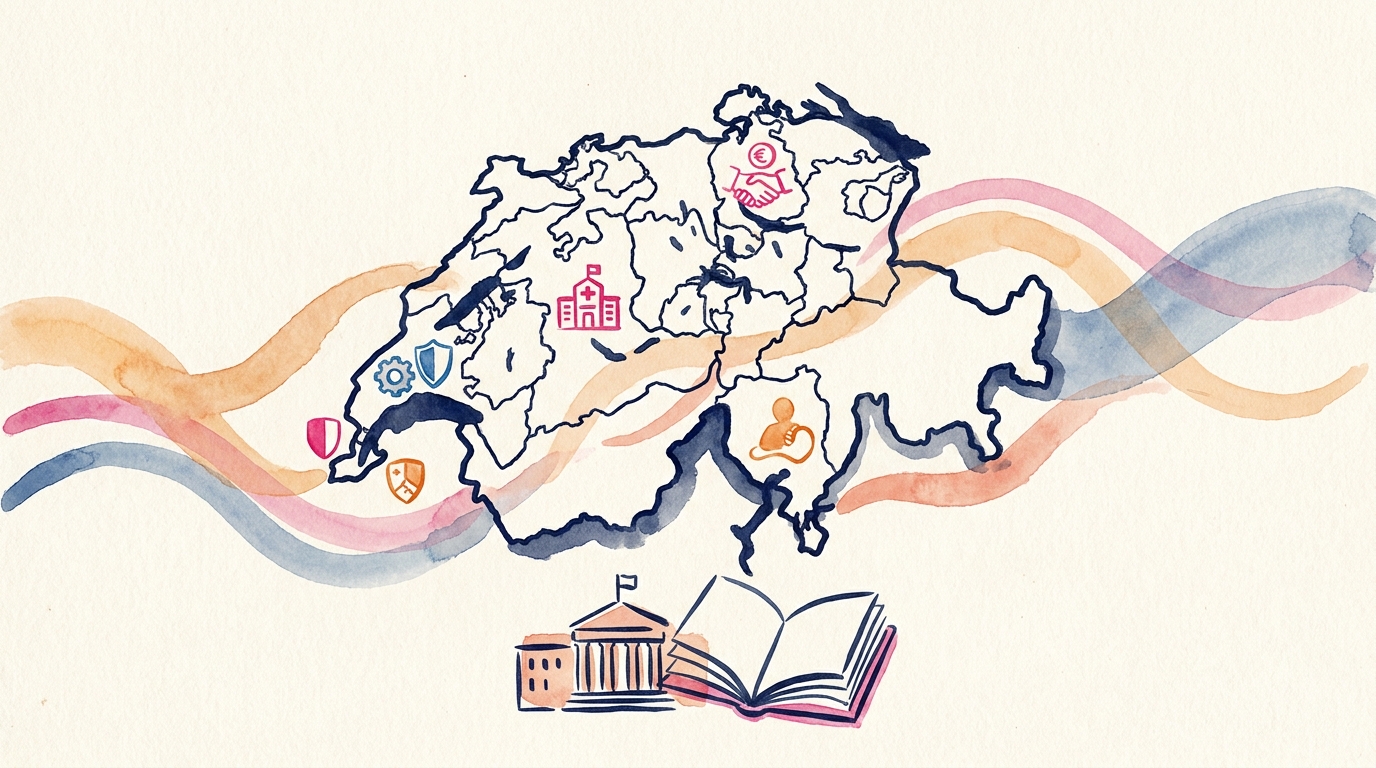
Three federally recognized cooperatives cover the entire Swiss territory:
- Cautionnement Romand (GE, VD, FR, NE, JU, VS): guarantees up to CHF 1 million of investment or operating credits for the creation, acquisition or development of SMEs. The federal ceiling rose from CHF 500,000 to CHF 1 million in 2022, a game-changer for mid-sized acquisitions.
- BG Mitte (BE, SO, BS, BL, AG Fricktal, LU, NW, OW): ceiling at CHF 500,000, focused on microenterprises and SMEs of the German-speaking plateau.
- BGOST (ZH, SG, AR, AI, TG, GL, GR, SH): up to CHF 1 million, with the same substantive criteria as Cautionnement Romand.
Cautionnement Romand does not replace personal equity, it complements it. The mechanism: the cooperative provides a guarantee to the bank, which then accepts a file it would have rejected without that coverage. The cost to the buyer is an annual commission (1 to 1.5 % of the guaranteed amount) added to the credit rate.
Cantonal programs in French-speaking Switzerland
In Geneva, the Fondation d'Aide aux Entreprises (FAE) plays a structuring role. It relays Cautionnement Romand up to CHF 1 million and can intervene, via an equity participation in own funds, up to CHF 4 million (all aids combined, capped at 45 % of the total invested). Nearly one third of its guarantees concern acquisitions. The FAE also offers a cash advance of CHF 250,000 maximum over 1 year, renewable, useful to bridge the first post-acquisition months. Fondetec, on the City of Geneva side, completes the framework for very small businesses.
Vaud, Fribourg, Neuchâtel and Valais have similar structures through their economic development services or cantonal banks. The SECO page on SME succession lists federal programs and provides entry points by canton.
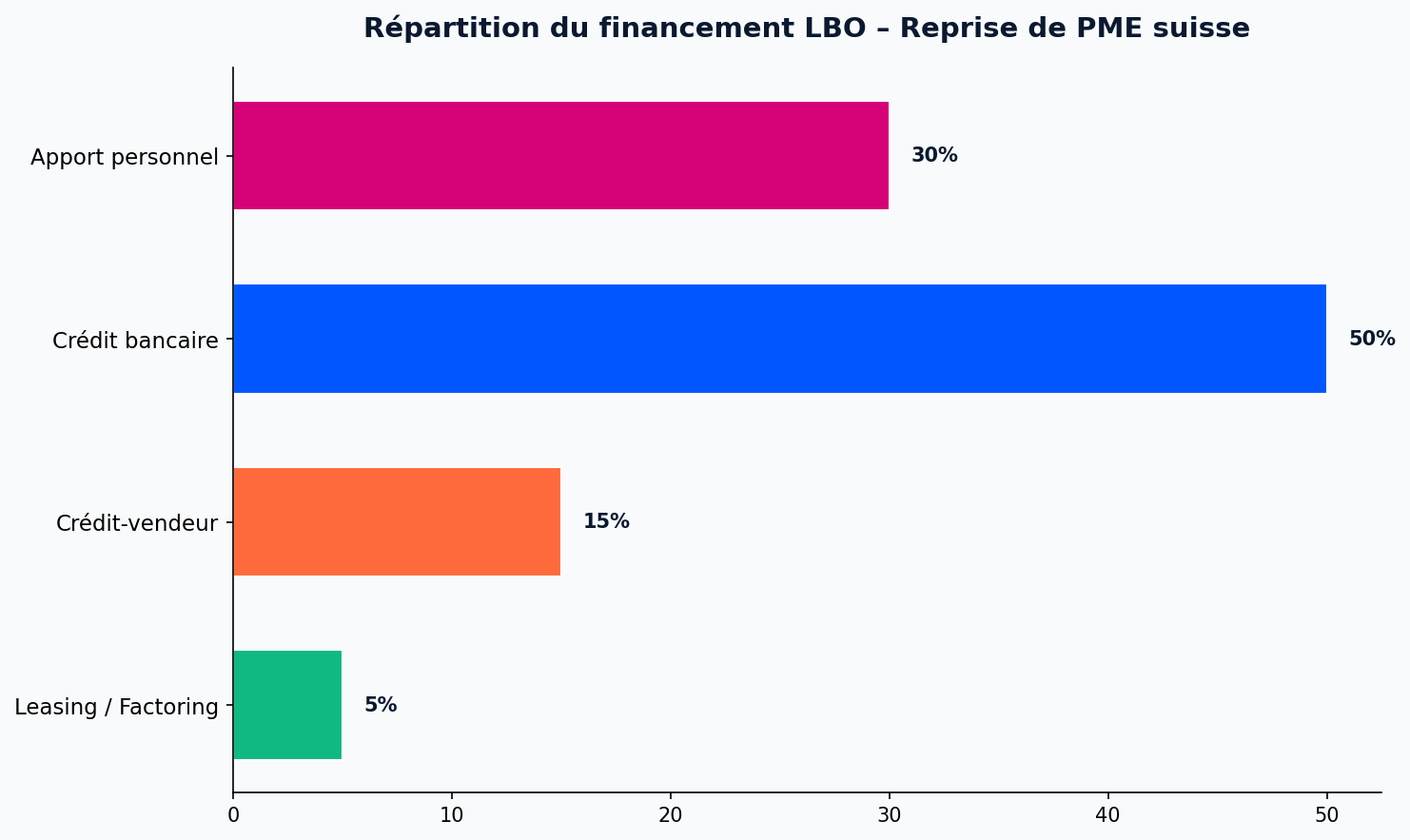
5. Leasing and factoring: preserving cash flow after the acquisition
A classic mistake among buyers: putting all financing capacity into the acquisition price, then running short of cash to keep the business running in the first months.
Leasing solves part of the problem. Rather than buying equipment and machinery with your cash, you lease them over 3 to 7 years. The charge is monthly, predictable, and preserves your capital for operations.
Factoring works on a different register: it lets you sell your customer receivables to a financial institution and collect immediately, without waiting 30 or 60 days. In an SME that just changed hands, shortening the cash cycle can make a real difference over the first 6 months.
Combined with an acquisition loan and seller financing, these two tools form what is called an LBO (Leveraged Buy-Out) structure: different sources of financing that distribute risk rather than concentrate it on a single creditor.
6. Equity and crowdfunding: complementary sources of own funds
When personal equity falls short and the bank requires more own funds, two avenues are worth exploring.
Business angels are private investors who provide capital in exchange for a minority stake. In Switzerland, structured networks such as SECA (Swiss Private Equity & Corporate Finance Association) or Business Angels Switzerland connect sellers, buyers and investors. Their value is not limited to money: they bring a network and sector experience that can accelerate post-acquisition development.
On the online platform side, two Swiss players are particularly relevant for acquisitions:
- Investiere connects Swiss SMEs and startups with a pool of around 1,000 qualified investors (minimum CHF 10,000 entry ticket). Relevant for high-growth-potential acquisitions or MBI (Management Buy-In) structured as capital companies.
- Swisspeers offers debt-based participative financing for SMEs (loans from CHF 50,000 to several millions, 1 to 3 year terms, typical 4 to 6 % yields). Useful as a complement to a main bank loan or as bridge financing while bank funds are being released.
These solutions dilute your stake (equity side) or increase your financial charges (debt side). They are evaluated with care: bringing in investors at the capital level means sharing decisions, not just profits.
7. The legal and tax structure: the choice that changes everything
Buying the shares or units of a company (capital acquisition) or buying its assets (machines, inventory, customer base): the two approaches have radically different tax and legal consequences.
On the seller side, the sale of shares held privately is in principle exempt from capital gains tax in Switzerland (art. 16 para. 3 LIFD), which explains the near-systematic preference of sellers for this scheme. On the buyer side, an asset purchase allows the acquisition value to be depreciated for tax purposes and leaves hidden liabilities (litigation, potential reassessments) with the seller. This tension structures most of the negotiation.
The topic goes well beyond the scope of this article. For details on legal structures (Sàrl, SA, sole proprietorship), AVS / VAT / employment law consequences, and pitfalls such as indirect partial liquidation (IPL), see our complete guide to business succession in Switzerland. One rule holds in all cases: this decision is made with a specialized tax advisor before signing. Revisiting it afterwards costs far more than dedicating two preparatory sessions to it upstream.
Case study: acquiring a Vaud restaurant at CHF 1.2 million
To visualize how these solutions fit together, take a concrete case. A 45-year-old buyer, former executive, targets an independent Lausanne restaurant valued at CHF 1,200,000 (CHF 800,000 of goodwill and CHF 400,000 of equipment and inventory). Target EBITDA CHF 220,000/year, seller wanting to hand over within 6 months.
Standard structure validated by a cantonal bank and Cautionnement Romand:
| Source | Amount | Share | Conditions |
|---|---|---|---|
| Personal equity (savings + 3rd pillar) | CHF 280,000 | 23 % | Cash available at signing |
| Bank loan (BCV or equivalent) | CHF 650,000 | 54 % | 10 years, ~3 % fixed rate, Cautionnement Romand on 50 % |
| Seller financing + earn-out | CHF 200,000 | 17 % | 4 years, 2.5 % rate, of which CHF 50,000 indexed to EBITDA |
| Kitchen equipment leasing | CHF 70,000 | 6 % | 5 years, payments built into operating P&L |
| Total | CHF 1,200,000 | 100 % |
The buyer keeps CHF 40,000 of cash out of the initial CHF 320,000 of savings to absorb working capital needs in the first three months. Cash flow available after debt service: roughly CHF 130,000 per year, enough to remunerate the buyer and finance growth.
Building a convincing file
None of these solutions are worth anything without a solid file. The bank, the guarantee organization, the seller, the investors: each one wants to understand where the money goes and how it comes back.
A credible financing file contains at minimum:
- A post-acquisition business plan with a market analysis and a concrete development project
- 3-year financial projections (P&L, balance sheet, cash flow) with justifiable assumptions
- The last 3 balance sheets and P&L statements of the target company
- A buyer CV highlighting their experience and sector understanding
Financial and legal due diligence is non-negotiable. It is what reveals hidden liabilities, ongoing litigation, fragile contracts. It also quantifies precisely what you are acquiring. Without serious due diligence, you finance an approximation. To frame the business value before structuring the financing, our article on valuing a business in Switzerland details the methods (EBITDA multiples, DCF, net asset value) used by fiduciaries.
PME-Market connects buyers with a network of expert partners (fiduciaries and financing advisors) to support this structuring phase. If you are actively searching, browse the businesses for sale in French-speaking Switzerland or our complete guide to buying a business in Switzerland.
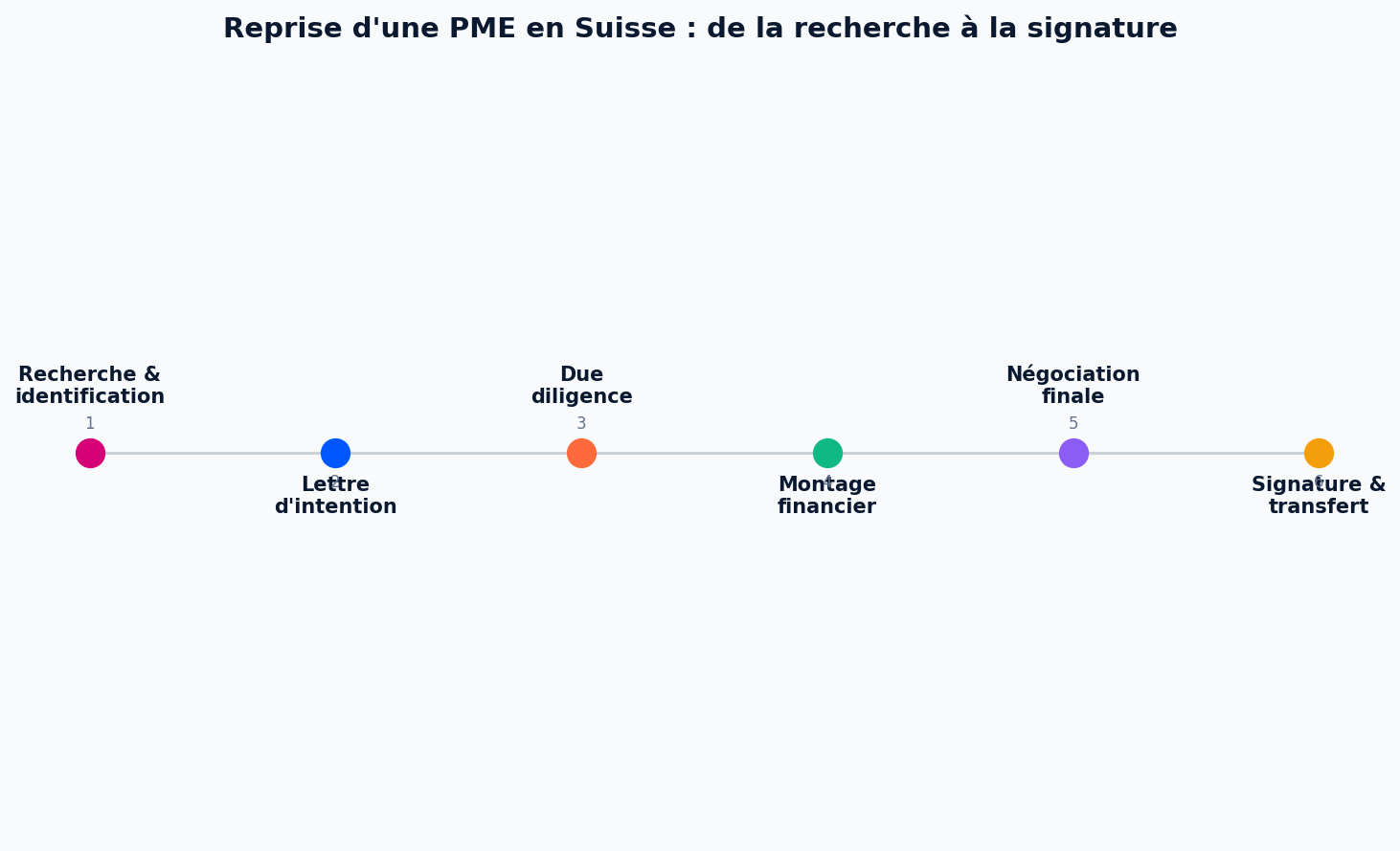
Calendar to plan for: between the decision to acquire, due diligence, negotiation and putting the financing in place, count 6 to 12 months for a well-prepared transaction. Rushed acquisitions are those that leave the most unpleasant surprises.
Frequently asked questions
How much personal equity is needed to acquire an SME in Switzerland?
Banks and financial partners generally require personal equity between 20 % and 50 % of the acquisition price. This percentage varies by sector, transaction size and file robustness. The higher the equity, the better the credit terms obtained.
What is seller financing and how does it work?
Seller financing is a mechanism where the seller agrees to receive 10 % to 30 % of the sale price on a deferred basis, typically over 2 to 5 years at a rate comparable to the bank loan. It reduces the bank financing need, aligns the seller's and buyer's interests, and can be coupled with an earn-out (price supplement tied to the company's future performance).
Are there public guarantees to finance an SME acquisition in Switzerland?
Yes. Three federally recognized cooperatives cover the territory: Cautionnement Romand (up to CHF 1 million, GE/VD/FR/NE/JU/VS), BG Mitte (CHF 500,000, BE/SO/BS/BL/AG/LU/NW/OW) and BGOST (CHF 1 million, ZH/SG/AR/AI/TG/GL/GR/SH). In Geneva, the FAE complements the framework with equity participations up to CHF 4 million and a cash advance of CHF 250,000.
Is it better to acquire the shares of an SME or its assets?
Both approaches have different consequences. A share purchase is operationally simpler but exposes the buyer to the full liabilities of the company, including unknown debts and litigation. An asset purchase lets the buyer select what is acquired and depreciate the value for tax purposes, but is more complex to structure. Sellers generally prefer share sales because they benefit from the capital gains tax exemption on private assets (art. 16 para. 3 LIFD), except in cases of indirect partial liquidation.
How long does it take to finalize the financing of an SME acquisition in Switzerland?
Between searching for the target, due diligence, negotiation and putting financing in place, count 6 to 12 months for a well-prepared transaction. Rushed acquisitions are the riskiest because they leave little time to identify hidden liabilities or structure a solid financing package.
What interest rate for an SME acquisition loan in Switzerland in 2026?
In 2026, the environment is favorable to buyers. With SARON near 0 % and a stable SNB policy, count on a total rate between 2 % and 4 % on an acquisition loan (SARON or fixed rate plus a bank margin of 1.5 % to 3 % depending on risk profile). The margin is higher than on a residential mortgage because the bank finances an operating business, not a physical asset. Cantonal banks (BCV, BCGE, BCN, ZKB) are often more flexible than UBS on smaller acquisition files.
Can I withdraw my 2nd pillar to finance an SME acquisition?
Yes, but only if you launch a sole proprietorship or a general partnership (SNC), not a Sàrl or SA. You must file the request within 12 months of AVS registration as self-employed, with your spouse's written consent. If you made a voluntary LPP buyback in the past 3 years, the pension fund will refuse the early payment (anti-abuse rule). Draining your pension to finance an acquisition remains a bet to discuss with a pension advisor.
Related articles
Businesses for Sale in French-Speaking Switzerland: 2026 Market Overview
2026 market overview of businesses for sale in French-speaking Switzerland: real prices, leading sectors, key legal points, and cantonal aid for buyers.
Selling Your Business Without a Broker: Is It Possible in Switzerland?
Selling your Swiss business without a broker is legally possible and saves 10-15% of the sale price. Learn the key steps, legal requirements, and how to value your business.